
Introduction
Let’s start here, because this question usually shows up quite frequently .
What does a ghost writer actually do?
You might be circling the idea of a book. Or an article. Or a body of work you know you should publish, but have not been able to finish. The concept of a ghostwriter feels both intriguing and slightly uncomfortable at the same time.
On the surface, it sounds simple. Someone writes. Someone else gets the credit.
In reality, it is rarely that clean.
Do they just polish what you already wrote?
Do they interview you and write everything from scratch?
Will it sound like you, or like someone pretending to be you?
Those questions are not naive. They are the right ones.
Ghostwriting lives at the intersection of storytelling, structure, and trust. When it is done well, you do not notice the writer at all. You recognize yourself on the page, only clearer, sharper, and more fully formed.
In this article, you will learn what a ghostwriter actually does, what they do not do, and how the process really works, so you can decide whether hiring professional ghostwriting services makes sense for you without the myths, the awkwardness, or the guesswork.
Quick Definition
Let’s get precise, because vague language is where most confusion starts.
A ghostwriter is a professional writer who creates content that is published under your name, not theirs. They are hired to write as you, not about you. That means the ideas, perspective, and authority come from you, while the execution on the page comes from them.
In practice, this looks less like outsourcing and more like collaboration.
A ghostwriter helps you take what already exists in your head and turn it into something coherent, readable, and intentional. They bring structure where there is sprawl. Clarity where there is noise. Shape where there is raw material.
People usually start searching for a ghostwriter services list when they realize one thing. The problem is not that they have nothing to say. The problem is that they do not have the time, distance, or writing discipline to say it well.
That is why ghostwriters are hired for the reasons below.
Speed: When Publishing Cannot Wait
You know what you want to say, but the calendar keeps winning.
Between meetings, deadlines, and life, writing becomes the thing you keep pushing to “next month.” A ghostwriter collapses that timeline. They turn months of stalled intention into weeks of forward motion, without sacrificing quality.
Speed here is not about rushing.
It is about momentum.
Expertise: When the Stakes Are High
Some content cannot afford to be average.
Books that represent your life’s work. Articles tied to your credibility. Thought leadership that positions you publicly. A ghostwriter brings professional writing expertise to moments where getting it wrong would cost you trust, reputation, or opportunity.
You bring the knowledge.
They make sure it lands.
Structure: When Ideas Feel Scattered
Most clients do not lack ideas. They have too many of them.
Notes everywhere. Half-finished drafts. Strong points buried under tangents. A ghostwriter sees the shape before it exists. They decide what comes first, what supports what, and what should be cut entirely.
Structure is what turns thinking into something readable.
Voice: When Sounding Like Yourself Actually Matters
This is where good ghostwriting separates from bad.
Voice is not just tone. It is rhythm, word choice, confidence level, and perspective. A ghostwriter studies how you speak, how you explain things, and how you make decisions, then mirrors that on the page.
The goal is simple.
If someone who knows you reads it, nothing should feel off.
Polish: When the Work Needs to Hold Up in Public
Drafts are private. Published work is permanent.
A ghostwriter refines language, tightens arguments, removes repetition, and smooths transitions. They make sure your ideas do not just exist, but arrive clean, confident, and ready for scrutiny.
Polish is not about sounding fancy.
It is about sounding finished.
What Ghostwriters Commonly Write
Once you understand the role, the next question is usually practical.
What, exactly, can a ghostwriter take on?
This is where the ghostwriter scope of work becomes important, because ghostwriting is not limited to a single format or outcome. It adapts to where your ideas need to live and how your audience consumes them.
Books: Memoirs, Business Books, Thought Leadership
Books are still the most visible form of ghostwriting.
Memoirs require emotional accuracy and restraint. Business books demand clarity, positioning, and credibility. Thought leadership books sit somewhere in between, turning lived experience into ideas others can apply.
In all cases, the ghostwriter helps shape a long narrative that holds together from first page to last, without losing your voice along the way.
Articles and Blogs for Executives, Experts, and Brands
Not every idea needs a book.
Many ghostwriters focus on articles and blogs that build authority over time. This might look like bylined pieces for executives, founder-led blogs, or expert commentary that positions you as a trusted voice in your space.
Consistency matters here. A ghostwriter helps maintain it without diluting your point of view.
Speeches, Talks, and Public-Facing Narratives
Writing for the ear is different from writing for the page.
Ghostwriters often work on keynote speeches, conference talks, panels, and public statements. These pieces need pacing, emphasis, and emotional beats that feel natural when spoken, not read.
The best ones sound effortless. They never are.
Scripts, Newsletters, and Long-Form Content Ecosystems
Modern ghostwriting extends beyond single assets.
Scripts for podcasts or video, ongoing newsletters, and interconnected content systems all fall within scope. The goal here is cohesion. One voice, one perspective, across multiple formats, over time.
When done well, the audience does not notice the system.
They just feel the consistency.
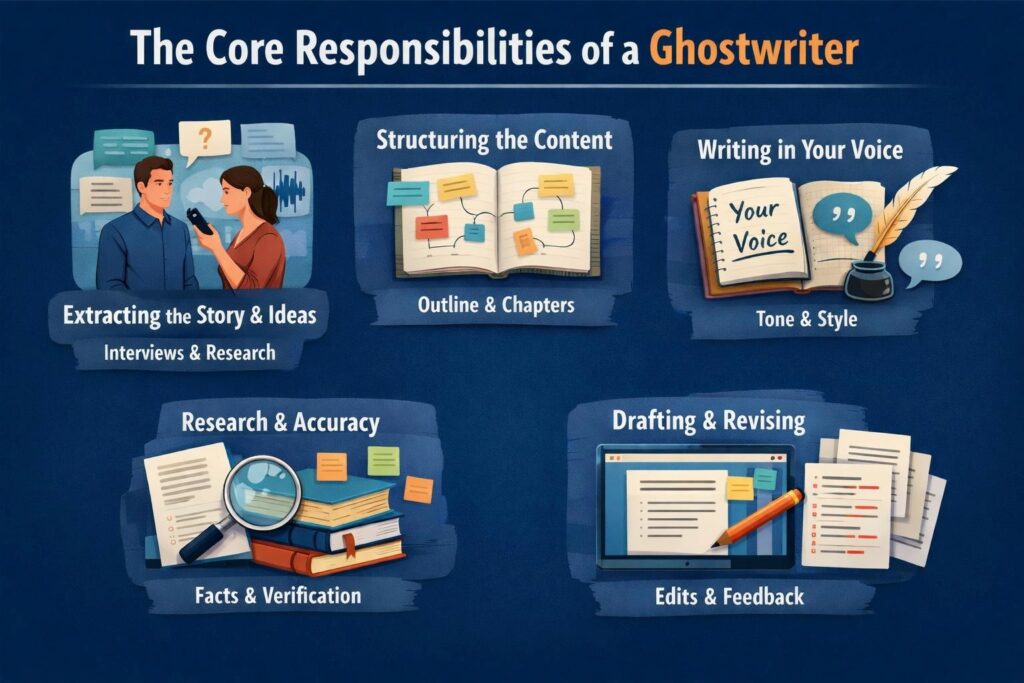
The Core Responsibilities of a Ghostwriter
This is the part most people underestimate. If you are still wondering what does a ghostwriter actually do, the answer lives in the day-to-day work, not the final byline.
Ghostwriting is less about typing and more about translation. Turning lived experience into language that holds up outside your head.
Extracting the Story and Ideas
Most clients do not arrive with a clean narrative. They arrive with memories, opinions, lessons, and fragments.
A ghostwriter pulls those out through interviews, calls, questionnaires, and transcripts. They listen for what matters, what repeats, and what carries weight. Often, they hear the real story before the client does.
This stage is about discovery, not polish.
Structuring the Content
Once the raw material is on the table, structure becomes everything.
A ghostwriter builds outlines, chapter plans, and narrative arcs that guide the reader logically and emotionally. They decide what comes first, what supports what, and what needs to be removed to protect clarity.
Without structure, even great ideas collapse under their own weight.
Writing in the Client’s Voice
This is not imitation. It is alignment.
A ghostwriter studies your tone, cadence, vocabulary, and point of view. They pay attention to how you explain things, where you pause, and what you emphasize. The goal is to write in a way that feels natural to you and familiar to your audience.
If the voice feels off, the work fails, no matter how good the writing is.
Research and Fact Support
Depending on the project, a ghostwriter may conduct background research, build timelines, verify details, and provide context. They flag weak claims, missing links, and areas that need support.
Good ghostwriters do not guess. They ask, check, and clarify.
Drafting and Revising
The final responsibility is execution over time.
Ghostwriters draft in milestones, revise based on feedback, and reshape sections until the work feels right. Revisions are not corrections. They are refinements guided by your input and decisions. The result is not just a finished draft. It is a piece of work you can stand behind with confidence.
What a Ghostwriter Is Not (Common Misunderstandings)
Clarity matters just as much around limitations as it does around capabilities. Many problems start when expectations drift beyond a realistic ghostwriter services list. When roles are blurred, timelines stretch, frustration grows, and the work itself suffers.
This is where those lines actually sit.
Ghostwriter vs. Editor vs. Book Coach
These roles overlap, but they are not the same.
An expert book editor improves text that already exists. A book coach guides you while you do the writing yourself. A ghostwriter writes the content for you, using your ideas, voice, and direction. The responsibility for the words on the page ultimately sits with the ghostwriter, even though the thinking behind them is yours.
Understanding this distinction upfront prevents disappointment later.
“I’ll Just Send Notes and They’ll Magically Make a Bestseller”
This belief causes more frustration than almost anything else.
Ghostwriters are skilled, not psychic. They still need context, access, and decisions from you. Notes help, but conversations matter more. The best results come from honest dialogue, not data dumps.
You do not need perfect clarity. You do need engagement.
What Ghostwriters Typically Do Not Handle
Most ghostwriters are not literary agents, publishers, or publicists.
They may offer guidance, referrals, or strategic insight based on experience, but representation, distribution, cover design, and promotion usually live outside the core scope unless explicitly contracted.
A professional ghostwriter will be clear about where their responsibility ends, and that clarity protects both sides of the collaboration.
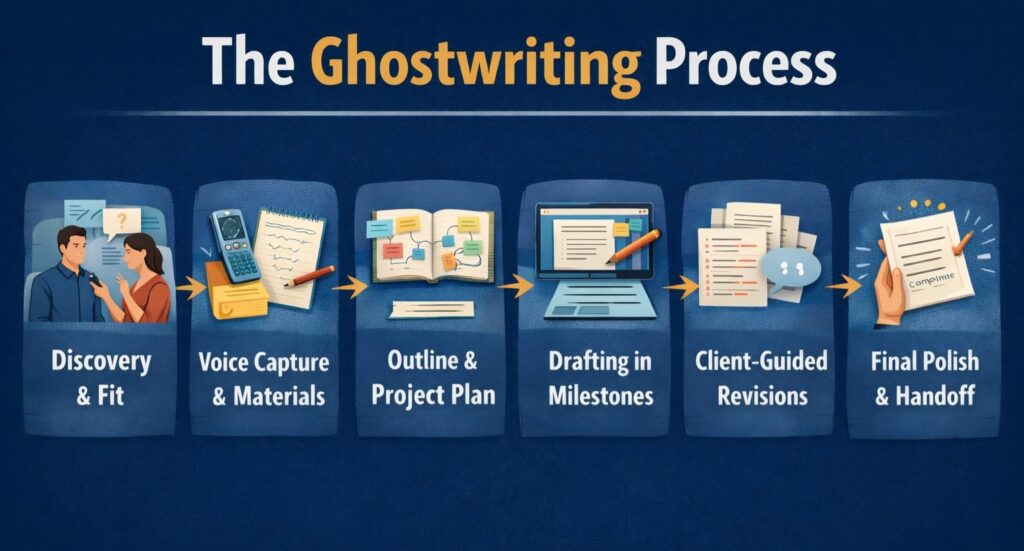
The Ghostwriting Process: What It Usually Looks Like
If you have never worked with a ghostwriter before, the uncertainty usually lives here. Not in the writing, but in the workflow. This is where having the ghostwriting process explained clearly makes the difference between a smooth collaboration and a stressful one.
While every writer has their own rhythm, most professional ghostwriting projects follow a similar sequence. Each step exists for a reason, and skipping one almost always creates problems later. The process is designed to reduce risk, protect your voice, and keep the work moving forward without guesswork.
Step 1: Discovery and Fit
This is the foundation.
Before a single word is written, there is a conversation about goals, audience, scope, voice, timeline, and collaboration style. This is where both sides decide if the project makes sense and if they can work together well.
A good ghostwriter will ask thoughtful, sometimes uncomfortable questions. That is a feature, not a flaw. These questions surface assumptions early, when they are easiest to correct.
Step 2: Voice Capture and Materials Gathering
Once the project begins, the focus shifts to understanding how you think and speak.
This usually includes interviews, recorded conversations, past writing, emails, speeches, journals, and any existing materials that reveal your perspective. The goal is not to copy your words, but to internalize your patterns.
The stronger this phase, the more natural the writing feels later, and the fewer revisions are needed.
Step 3: Outline and Project Plan
Before heavy drafting starts, structure is agreed upon.
This might be a chapter map, content plan, or narrative framework. You review it, challenge it, and approve it. This step ensures you are aligned on direction before significant time is invested.
It is much easier to move a heading than a finished chapter, and this phase saves time on both sides.
Step 4: Drafting in Milestones
Instead of disappearing for months, the ghostwriter delivers work in stages.
Sections or chapters are shared according to a schedule, allowing you to review tone, pacing, and substance early. This reduces risk and keeps the project on track.
Momentum is built through steady progress, not big reveals, and trust grows with each delivery.
Step 5: Revisions and Client-Guided Rewrites
Feedback is where collaboration deepens.
You respond to what feels right, what feels off, and what needs more depth. The ghostwriter translates that feedback into revisions that strengthen the work without losing coherence.
Revisions are part of the process, not a sign something went wrong. They are how good work becomes strong work.
Step 6: Final Polish and Handoff
The final stage focuses on refinement.
Language is tightened, inconsistencies are resolved, and the manuscript is prepared for the next phase, whether that is editing, design, or publishing. The work leaves the ghostwriter’s hands clean, coherent, and ready. At this point, the project is no longer in progress.
It is complete and positioned for what comes next.
Confidentiality, Credit, and Contracts (What’s Usually Included)
This is the part people tend to gloss over, right up until it matters.
If you are still asking what does a ghostwriter actually do, the answer also includes protecting you, your ideas, and the work itself. The writing is only one piece. The professional framework around it is just as important, especially when the content represents your reputation, expertise, or life story.
Confidentiality and NDAs
Confidentiality is standard in ghostwriting.
Most ghostwriters sign non-disclosure agreements that prevent them from discussing the project, sharing drafts, or revealing the relationship. This protects your ideas, your reputation, and your right to control the narrative.
For many clients, confidentiality is the primary reason they hire a ghostwriter instead of a co-author. Silence is not an add-on.
It is part of the service.
Rights and Ownership
Ownership is defined by contract, not assumption.
Many ghostwriting agreements are structured as work-for-hire, meaning you own the text outright once payment terms are met. In other cases, rights may be assigned after completion or limited by specific usage terms.
This section should also clarify whether the ghostwriter can reference the project privately or use excerpts as anonymized samples. These details matter later.
Deliverables, Payment Structure, and Revisions
Professional ghostwriting contracts spell out:
- What is being delivered
- How many drafts or revision rounds are included
- When payments are due
Clear milestones prevent misunderstandings and keep momentum steady. When expectations are written down, trust becomes easier to maintain.
Ethics and Transparency (When It Matters)
Ghostwriting is widely accepted in publishing, business, and media.
Ethical issues only arise in specific contexts where disclosure is required or where authorship is misrepresented in a way that misleads an audience. In most cases, credit choices are private and contractually agreed upon.
When expectations are aligned, ghostwriting remains exactly what it should be.
A professional collaboration built on trust and discretion.
What a Client Needs to Provide for a Ghostwriter to Succeed
Hiring a ghostwriter is not a handoff. It is a partnership. Even the most comprehensive ghostwriter services list cannot compensate for missing input from the client.
When projects stall, it is usually not because of writing quality. It is because one of the elements below is missing or inconsistent. Ghostwriting works best when both sides show up with clarity and commitment.
Time and Access
You do not need to be available every day, but you do need to be reachable.
Ghostwriters rely on interviews, follow-up calls, and occasional clarification. These conversations are where nuance lives. Without access, the writing becomes generic, no matter how skilled the writer is.
Think of this time as front-loaded. A few focused conversations early often save weeks of revisions later.
Raw Materials
Notes, timelines, documents, emails, voice memos, and past writing all matter.
These materials provide texture and specificity. They help the ghostwriter understand not just what happened, but how you experienced it and why it mattered. Small details often become the most resonant moments on the page.
Messy is fine. Sparse is not.
Honest Feedback
Polite feedback slows everything down.
What helps is honesty. What feels true? What feels off? What sounds like you and what does not? Ghostwriters translate your reactions into better drafts, but only if you are clear about them.
You are not grading the writing.
You are calibrating the voice.
Clear Decision-Making
Every project needs a decision-maker.
Endless tweaks, shifting preferences, and delayed approvals drain momentum. Clear yeses and nos keep the work moving and protect the integrity of the final piece.
When decisions are timely, the writing stays sharp and focused.
Trust in the Process
One final element is often unspoken.
You need to trust the process long enough for it to work. Early drafts are not meant to be perfect. They are meant to reveal direction. If you allow space for development instead of expecting polish on day one, the final result will be stronger, more cohesive, and more recognizably yours.
How to Hire the Right Ghostwriter
Finding the right ghostwriter is less about talent in isolation and more about alignment. The ghostwriter scope of work has to match your goals, your working style, and the level of involvement you want to have throughout the project.
A brilliant writer who is wrong for you will still produce the wrong result. Chemistry, communication, and expectations matter just as much as writing skill.
Where to Look
There are a few common paths.
Agencies offer vetted writers and structured processes, but they often come with higher costs and less flexibility. You may also have less direct access to the writer during the project. Referrals can be excellent if the person recommending them understands your voice and objectives, not just the outcome they achieved.
Platforms and marketplaces provide access to a wide range of writers at different price points. The trade-off is that you need to invest more time reviewing samples, interviewing candidates, and confirming professionalism.
Each option trades convenience for control, and neither is inherently better.
How to Evaluate Candidates
Start with voice.
Read samples and ask yourself a simple question. Can you imagine your name on this work without wincing? Then go deeper. Ask how those samples were created and how closely they resemble the client’s original voice.
Process matters as much as prose. A strong ghostwriter can explain how they manage timelines, feedback, and revisions without hand-waving. Pay attention to how clearly they communicate before any contract is signed. That is usually a preview of how the project will run.
Confidentiality comfort matters too. If you hesitate to share details, the writing will lack depth.
Questions to Ask on a Consult Call
Good consult calls feel calm and structured, not rushed or salesy.
Useful questions include:
- How do you capture a client’s voice?
- What does your milestone schedule look like?
- How do revisions work?
- What is included in the fee and what is considered extra?
- How do you handle disagreements about direction?
Listen not just to the answers, but to the confidence behind them. The right ghostwriter will not promise perfection. They will promise a process that gets you there.
Costs and Timelines: What’s Realistic (Without Fake Precision)
This is usually where people want a straight answer and get frustrated when they do not receive one. That frustration makes sense. You are trying to plan. The problem is that ghostwriting does not price well in shortcuts.
Costs and timelines are shaped by the work itself, not by templates.
What Drives the Cost of Ghostwriting
Pricing is influenced by more than word count.
Key factors include scope, research depth, complexity of ideas, speed of delivery, and how precisely the writer needs to match your voice. A straightforward business book based on clear interviews is a very different project from a memoir that requires emotional sensitivity, verification, and structural rebuilding.
The more thinking and interpretation involved, the higher the cost tends to be.
What Influences the Timeline
Timelines follow logic, not optimism.
Word count matters, but access matters more. Prompt interviews and timely feedback keep projects moving. Delayed decisions and extended revision cycles stretch timelines quickly.
Writing can be fast. Waiting rarely is.
Ghostwriting vs. Editing and Proofreading
It helps to separate creation from refinement.
Ghostwriting focuses on generating the content itself. Editing and polishing are often separate phases that happen after the manuscript is complete. Some clients choose to add affordable proofreading services at the very end to catch surface-level errors once no further changes are planned.
This layered approach protects the quality of the final work.
Why Exact Numbers Are Rare
Be cautious with precise promises.
Anyone who offers a fixed price and finish date without understanding your material is guessing. Realistic planning comes from clarity about scope, access, and expectations, not from overly confident estimates.
FAQs
1. Do ghostwriters just edit, or do they write from scratch?
Most ghostwriters write from scratch. They use interviews, notes, transcripts, and conversations as raw material, then craft the content themselves. Editing is part of the process, but it is not the primary function.
2. Will the book or article still sound like me?
Yes, if voice capture is done properly. A ghostwriter studies how you speak, explain ideas, and make decisions. The goal is not to impress readers with clever language, but to make the work feel recognizably yours.
3. How much time will I personally need to spend?
More than you think at the beginning. Less than you fear overall. Expect interviews and feedback cycles. You will not be writing pages, but your involvement shapes the final result.
4. Is ghostwriting legal?
Yes. Ghostwriting is legal when both parties agree via contract. Problems only arise when ghostwriting is used to misrepresent authorship in regulated or academic contexts.
5. Do I own the work?
Often, yes. Many agreements are structured as work-for-hire or include rights assignment upon completion. Always confirm this in writing.
6. Do ghostwriters sign NDAs?
Commonly, yes. Non-disclosure agreements are standard and protect both the client and the writer.
7. What’s the difference between a ghostwriter and a co-author?
A co-author receives public credit. A ghostwriter usually does not. The work may look similar behind the scenes, but the attribution is different.
8. Can a ghostwriter help with publishing or marketing too?
Sometimes. Some ghostwriters offer guidance or referrals, but publishing and marketing are usually separate services with separate fees.
9. How do revisions usually work?
Revisions are handled through defined rounds tied to milestones. Feedback is discussed, interpreted, and incorporated by the ghostwriter, rather than rewritten by the client.
10. What should be in a ghostwriting contract?
At minimum, confidentiality terms, deliverables, payment structure, revision limits, and rights ownership. Clear contracts protect the relationship and keep the focus where it belongs. On the work.
Conclusion
At some point, the question stops being what does a ghostwriter actually doand becomes something more personal.
Do you want your ideas to stay where they are, or do you want them to live outside your head in a form other people can actually engage with?
Ghostwriting is not about shortcuts or hiding. It is about translation. Taking lived experience, hard-won insight, or long-held stories and shaping them into language that holds up in public. The work is collaborative, structured, and far more intentional than most people expect.
When it works, you do not feel replaced. You feel clarified. Your thinking becomes sharper. Your voice becomes more consistent. The message you have been carrying finally has somewhere to land. That is the real value of a ghostwriter. Not the words themselves, but the distance, discipline, and craft it takes to turn what you know into something others can read, trust, and remember.