
Introduction
You want to write for a living. Quietly. Behind the scenes. No spotlight. No byline. Just clean words that make someone else look sharp.
And yet, you keep running into the same wall.
Every guide seems to assume you already have clips, clients, or a publishing history. You do not. You are stuck wondering if it is even possible to start ghostwriting with no experience or if that is just something people say to sound encouraging.
Here is the uncomfortable truth.
Most professional ghostwriters did not start with credentials. They started with intent, a few smart samples, and a willingness to learn someone else’s voice better than their own.
I have seen this play out again and again. Writers who stop waiting for permission and start building proof get hired. Writers who chase perfect readiness stay invisible.
In this guide, you will learn exactly how to move from zero to credible. You will learn what ghostwriting actually is, how to choose a niche without boxing yourself in, how to build a portfolio from thin air, and how to land your first client without sounding new or desperate.
What Ghostwriting Is (and What It Isn’t)
Before you pitch anyone, you need to understand the job you are actually signing up for.
Ghostwriting is writing content that is published under someone else’s name. The ideas may be theirs, yours, or a mix of both. But once the work is delivered and paid for, the voice belongs to them, not you.
That means your success is measured differently. You are not trying to sound impressive. You are trying to sound accurate. When a reader says, “This sounds exactly like them,” you did your job.
What ghostwriting usually includes
- Books for founders, executives, and creators
- Blogs and long-form articles published under a personal brand
- Newsletters that build trust week after week
- LinkedIn posts written in a distinct, recognizable voice
- Speeches and scripts that must sound natural when spoken
What ghostwriting is not
Ghostwriting is not:
- Co-authoring with shared credit
- Editing rough drafts line by line
- Copywriting focused on direct sales
- Plagiarism or rewriting someone else’s work
Those are different services with different expectations.
If you are new, here is one of the most useful beginner ghostwriting tips you can internalize early: your job is not to sound like a great writer. Your job is to sound like them, on their best day, with clarity and intention.
Once you understand that distinction, everything else in this guide starts to make sense.
Can You Become a Ghostwriter Without Experience?
Yes. And the reason is simpler than you think.
When clients say they want “experience,” they are not asking for a decade-long resume. They are asking one quiet question: Can I trust you to make me sound good and not create more work for me?
What “Experience” Actually Means
In ghostwriting, experience is just proof of two things:
- Skill: you can write clearly, adapt voice, and structure ideas
- Reliability: you hit deadlines and follow a process
That proof does not have to come from paid work.
What Counts as Real Proof
Clients will gladly accept:
- Strong writing samples
- A clear and confident workflow
- Small wins like feedback or testimonials
- Evidence you understand their audience and platform
Most beginners get stuck because they wait for permission. The ones who move forward create their own proof and put it in front of the right people.
This is where many writers accidentally overcomplicate things. You do not need dozens of clips or a famous name attached to your work. You need enough clarity and confidence to start conversations and handle them professionally.
Ironically, once you understand this, finding first ghostwriting clients becomes less about convincing and more about showing. Showing how you think. Showing how you write. Showing that working with you will feel easy, not risky.
That shift is what turns “no experience” into a non-issue.
Choose Your Ghostwriting Niche (So You’re Not Competing With Everyone)
One of the fastest ways to stall your progress is trying to write for everyone at once.
When you market yourself as “a ghostwriter for anything,” you disappear into noise. When you choose a niche, you give people a clear reason to hire you. This focus is especially important when you want to start ghostwriting with no experience, because specificity creates trust faster than ambition ever will.
A niche does not trap you. It anchors you. It gives your outreach direction, your portfolio coherence, and your pitches confidence. Clients do not want a generalist. They want someone who understands their world without constant explanation.
Five Beginner-Friendly Ghostwriting Lanes
1. Blog and Article Ghostwriting
Long-form content for founders, consultants, and brands. This lane rewards structure and research and is forgiving while you sharpen your voice-matching skills.
2. LinkedIn and Newsletter Ghostwriting
Short, frequent writing with a heavy emphasis on tone and rhythm. Demand is high, feedback is fast, and retainers are common.
3. Podcast-to-Article Repurposing
You turn spoken ideas into polished written assets. This is efficient, valuable, and ideal if you prefer organizing ideas over generating them from scratch.
4. Short eBooks and Lead Magnets
Clear scope, defined outcomes, and strategic value for clients building authority or email lists.
5. Book Ghostwriting
Long timelines and high expectations. Powerful work, but best tackled after you have built systems and confidence.
How to Choose the Right Niche
Ask yourself a few honest questions:
- What topics can I write about repeatedly without burning out?
- How much research am I willing to do per project?
- How strong is my ability to adapt to someone else’s voice?
- Do I prefer short, fast projects or long-term commitments?
If two niches feel equally viable, choose the one with faster feedback. Early momentum matters more than long-term perfection. You can always pivot later, but you cannot build confidence without shipping work.
Pick a lane. Stay there. Let traction do the rest.
Build a Portfolio When You Have Zero Clients
No clients does not mean no proof. It means you have not packaged your proof yet.
A ghostwriting portfolio is not a trophy case. It is a trust shortcut. Its only job is to show a potential client that you can think, write, and adapt like a professional. That is it.
Many beginners make the mistake of waiting for “real” work before creating samples. That wait quietly kills momentum. Your portfolio is not a record of the past. It is a signal of what you can deliver right now.
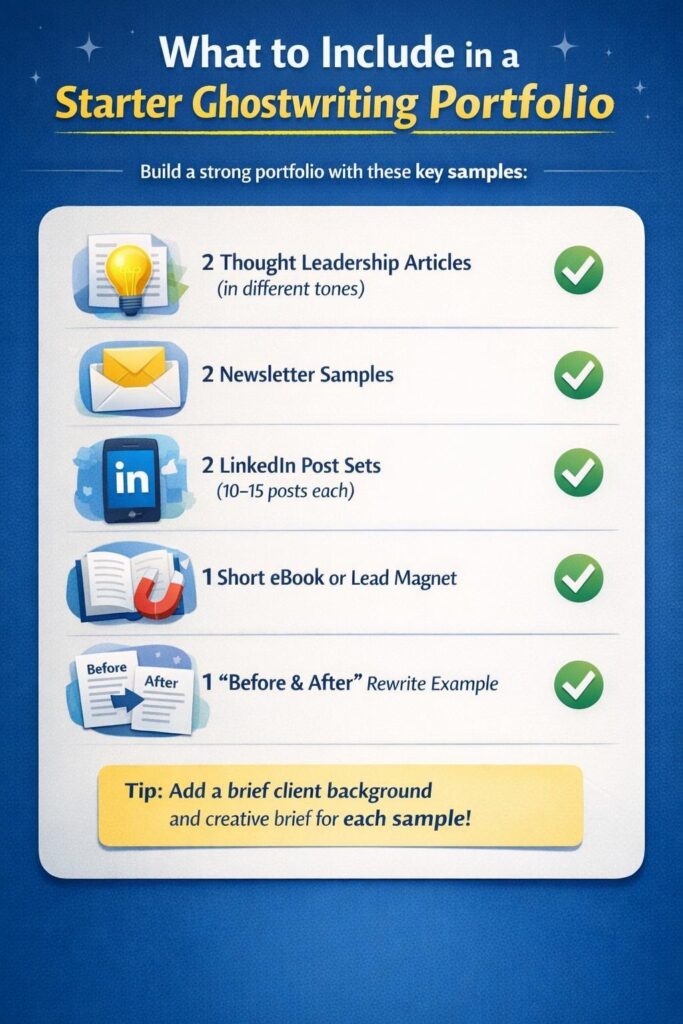
What to Include in a Starter Portfolio
Aim for six to ten pieces that show range and control:
- Two thought-leadership articles written in different tones
- Two newsletter issues with a clear point of view
- Two LinkedIn post sets, ten to fifteen posts each
- One short lead magnet or eBook sample
- One before-and-after rewrite that shows voice transformation
This mix signals versatility without chaos. You are showing depth, not dabbling.
Where to Host Your Portfolio
Keep it simple:
- A Google Doc clip book
- A Notion page
- A basic one-page website
Accessibility matters more than design. If it takes effort to open, it creates friction. Clients want to skim, not explore.
How to Make Samples Feel Real
Write for a hypothetical client persona. Give them a name, an industry, and a clear audience. Then add a short creative brief at the top explaining the goal, tone, and platform.
This is one of the most practical beginner ghostwriting tips you can apply early: always frame the work. Context sells the writing. It shows strategic thinking, not just wordsmithing.
If you want to go one step further, note what feedback you would expect from the client and how you would revise. That signals maturity. At this stage, clarity beats perfection every time.
Learn the Core Ghostwriting Skills Clients Actually Pay For
Talent opens the door. Skills keep you in the room.
Below is what clients are actually paying for, explained plainly. These are not abstract ideas. They are practical skills you use on every project, whether you are writing a LinkedIn post or a book chapter.
Voice Matching
- Sentence length and pacing
Some people think in short, punchy bursts. Others ramble, circle, and land softly. Matching this rhythm matters more than fancy wording. If your pacing is off, the voice feels fake even if the ideas are right. - Preferred vocabulary and repeated phrases
Everyone has linguistic habits. Certain words they love. Certain words they never use. Track these and follow them strictly. Consistency creates believability. - Formality, humor, and emotional range
Is the client blunt or diplomatic? Dry or expressive? Do they joke often or stay serious? Voice matching means staying inside those boundaries at all times. - Storytelling versus direct instruction
Some clients lead with stories. Others hate them. Knowing which one you are dealing with prevents unnecessary revisions.
Interviewing and Extracting Stories
- Asking open-ended questions
Questions like “Tell me about a time when…” unlock better material than yes-or-no prompts. You are guiding, not interrogating. - Interrupting with intention
When a client touches something interesting, you pause them and dig deeper. This is where the expert book writing insight lives. - Listening for emotional signals
Pay attention to moments where they speed up, slow down, or get animated. Those moments usually hide the strongest content. - Clarifying vague ideas immediately
If something sounds fuzzy, it will read fuzzy. Clarify during the call, not during revisions.
Outlining and Structure
- Defining the core message early
Every piece needs a clear takeaway. Without it, content drifts and feedback becomes subjective. - Mapping the flow of ideas
Outlines show how one idea leads to the next. This reduces confusion and keeps writing focused. - Placing stories and examples intentionally
Stories should support ideas, not interrupt them. Structure decides where they belong. - Aligning expectations before drafting
A shared outline prevents “this isn’t what I meant” conversations later.
Research and Fact-Checking
- Vetting sources quickly
You need to know which sources are reliable and which are noise. Speed matters. - Separating opinion from fact
Clients often blend the two. Your job is to label them correctly so credibility stays intact. - Avoiding over-research
More information does not equal better writing. Research until the idea is supported, then stop.
Revision Management
- Setting clear feedback rules
Decide where feedback lives and how it should be phrased. This prevents scattered notes and miscommunication. - Limiting revision rounds
Unlimited revisions signal uncertainty. Clear limits signal professionalism. - Tracking changes cleanly
Version control keeps everyone calm. Confusion creates doubt, even when the writing is strong.
When you execute these well, clients stop worrying. And when clients stop worrying, they keep paying.
Set Up Your Offer (What You Sell, Exactly)
Vague offers scare clients.
If someone cannot immediately understand what you do, how it works, and what they get, they will hesitate. When you are trying to start ghostwriting with no experience, clarity does the heavy lifting that credentials usually would.
You are not selling “writing.” You are selling a clear outcome with clear boundaries.
Starter Ghostwriting Service Packages
- LinkedIn ghostwriting
This typically includes ideation, writing, and light editing for short-form posts published under the client’s name. Posting four times per week keeps visibility high without overwhelming the client. Your job is to maintain voice consistency, respond to platform norms, and deliver ready-to-post content. - Newsletter ghostwriting
Two issues per month is a manageable cadence for beginners. This service often includes outlining, drafting, and polishing long-form emails that educate or build trust with subscribers. Repurposing means turning the same ideas into smaller content pieces, increasing value without doubling your workload. - Blog ghostwriting
Four posts per month creates a predictable publishing rhythm. This service usually involves topic research, outlining, drafting, and basic SEO optimization. The goal is authority and long-term visibility, not aggressive selling.
Define Deliverables in Plain Language
- Length or quantity of content
Specify word counts or post numbers so expectations are fixed from the start. - Platforms and formats included
State exactly where the content will live and how it will be delivered. - Turnaround time
Clear timelines reduce anxiety and prevent rushed feedback. - Number of revision rounds
Setting limits protects your time and prevents endless tweaks.
Why Specific Offers Build Trust
Specific offers signal professionalism. They show you understand scope, process, and outcomes. Clients feel safer when boundaries exist, because it means fewer surprises later.
Confidence is not loud. It is precise.
How to Find Your First Ghostwriting Clients
This is where hesitation usually shows up.
Outreach feels exposed. Silence feels personal. But once you break the process down, it becomes mechanical. Finding first ghostwriting clients is not about confidence or charisma. It is about understanding where opportunities live and how to approach them without friction.
Best Beginner Channels
- Warm network and referrals
These are people who already know your work ethic. Former coworkers, managers, classmates, or friends who run businesses. You are not asking for favors. You are announcing a service and inviting conversations. Trust already exists, which shortens the decision cycle. - Communities
Founder groups, creator Slack channels, Discords, and online forums often hide real opportunities. The key is participation first. Answer questions. Share insight. Let people see how you think before you ever mention services. - Freelance platforms
These platforms are useful training grounds. They teach you how to scope projects, manage expectations, and deliver on deadlines. Treat them as practice and proof, not a permanent home. - Agencies and content studios
Agencies need dependable writers who can follow briefs and hit deadlines. They care less about your personal brand and more about execution. One strong agency relationship can quietly lead to consistent work.
A Simple Outreach System
- Identify 20 targeted prospects per week
Focus on people already publishing content but doing it inconsistently or poorly. They already understand the value of writing. - Send short, personalized messages
One line that proves you actually read their content dramatically increases response rates. - Follow up five times
Most replies happen after multiple touches. Silence usually means busy, not uninterested.
What to Say When You Reach Out
- One specific observation
Call out something concrete in their content. Vague praise does nothing. - A quick suggestion
Offer a clear improvement to show how you think. - A short sample paragraph
Writing in their voice removes risk. It lets them feel the outcome before committing.
When you treat outreach like a system instead of a judgment of your talent, it stops being scary and starts producing results.
Pitching and Discovery Calls (So You Don’t Sound New)
The call is not a performance. It is a filter.
Clients are not testing your writing ability in that moment. They are testing whether working with you will feel organized, predictable, and low-stress. When you are trying to start ghostwriting with no experience, structure replaces status.
Below is what each discovery call element actually does and why it matters.
Discovery Call Questions That Matter
- Audience and goals
This clarifies who the content is for and what it should achieve. Writing for everyone leads to writing that works for no one. Goals turn subjective feedback into objective decisions. - Positioning
Positioning defines the role the client wants to play in their market. An authority sounds different from a peer. A challenger sounds different from a teacher. Tone flows from this choice. - Must-say and never-say topics
These boundaries protect both of you. They prevent accidental missteps and reduce revision cycles caused by unspoken preferences. - Voice references
Examples act as a shared language. Instead of guessing, you can study cadence, vocabulary, and structure that already resonate with them. - Approval flow and deadlines
Knowing who approves content and how long feedback takes prevents bottlenecks. This is operational clarity, not admin trivia.
How to Propose Without Overexplaining
- Summary of goals
This proves you listened. Clients want to feel understood before they care about deliverables. - Clear deliverables
This sets expectations and prevents scope creep. Specificity builds trust. - Timeline and cadence
Regularity creates momentum and accountability on both sides. - Price and payment terms
Transparent pricing avoids awkward follow-ups and signals professionalism. - Next steps
Clear next actions keep deals moving forward instead of stalling in indecision.
You do not sound experienced by talking more. You sound experienced by making the process feel obvious.
Pricing: What Should a Beginner Ghostwriter Charge?
Pricing feels emotional because money feels personal. But pricing is not about your worth. It is about scope, risk, and responsibility. Once you see it that way, decisions get easier.
Below is what each option actually means in practice.
Common Ghostwriting Pricing Models
- Per word
You charge based on the number of words delivered. This model is easy to understand but often works against you. It rewards longer drafts instead of better thinking and can lead clients to fixate on word counts instead of outcomes. - Per project
You quote one price for a clearly defined deliverable. This model encourages you to think in terms of results rather than volume. It also protects your time as you become faster and more skilled. - Monthly retainer
You provide ongoing work for a fixed monthly fee. This model creates income stability and deeper client relationships. It requires clear boundaries and consistent output to work well.
Why Ghostwriting Rates Vary So Widely
- Scope and volume of work
More pieces, longer formats, or multi-platform delivery increases responsibility and price. - Research depth required
Original research, interviews, or technical topics demand more time and energy. - Subject-matter complexity
Writing about leadership differs from writing about medicine or finance. Risk raises rates. - Turnaround time
Rush work costs more because it displaces other commitments.
A Smart Beginner Pricing Strategy
- Clearly defined scope
Scope is your first line of protection. It spells out exactly what is included and, just as importantly, what is not. This means defining the number of pieces, word counts or post limits, platforms, research level, and delivery cadence. When scope is clear, feedback becomes specific and disputes become rare. Clients relax because expectations are visible. You relax because your workload is predictable. - Capped revisions
Unlimited revisions quietly destroy timelines and morale. A clear cap sets a professional boundary and forces better feedback. It encourages clients to think before responding instead of reacting emotionally. You can always choose to be flexible, but flexibility should be intentional, not assumed. Revision limits signal confidence and experience, even at beginner rates. - A price you can deliver confidently
Confidence affects how clients evaluate risk. If you hesitate when stating your price, clients hesitate too. Choose a rate that lets you focus on doing good work instead of worrying whether you charged too much or too little. Early on, psychological comfort matters. When you deliver calmly and consistently, raising your rate later feels natural instead of forced.
Pricing is not a statement of identity. It is a tool. Use it to protect your time and signal clarity.
Contracts, Credit, and Confidentiality (Don’t Skip This)
Contracts feel intimidating until you need one. Then they feel essential.
When you are trying to start ghostwriting with no experience, a clear contract replaces assumptions with agreements. It protects your time, your work, and the relationship itself.
Below is what each clause actually does and why it matters.
Key Contract Clauses to Include
- Confidentiality and NDA
This clause confirms that anything shared during the project stays private. Clients often reveal unpublished ideas, personal stories, or business strategy. An NDA reassures them and sets clear limits on what you can discuss or share publicly. - Ownership and copyright terms
This defines who owns the work and when ownership transfers. In most cases, the client receives full rights after final payment. Without this clause, ownership can be legally unclear, which creates risk for both sides. - Deliverables, deadlines, and revision limits
This section translates your offer into legal language. It specifies exactly what you will deliver, when you will deliver it, and how many revisions are included. Clear definitions prevent scope creep and endless back-and-forth. - Kill fee and cancellation terms
Projects end unexpectedly. A kill fee ensures you are compensated for time and work completed if the client cancels mid-project. This clause turns uncertainty into fairness.
Credit and Portfolio Rules
- Uncredited work expectations
Ghostwriting usually means no public byline. This should be clearly acknowledged so there are no mismatched expectations later. - Sharing excerpts privately
Some clients allow you to show work privately to prospects. Others do not. This must be explicitly stated. - Anonymized samples
In some cases, you can remove identifying details and use the work as a sample. This protects confidentiality while allowing you to build proof. - Testimonials and case studies
Even if you cannot show the work, a testimonial or anonymized case study can still be powerful.
Clarity here prevents awkward conversations later. Contracts are not bureaucracy. They are professionalism in written form.
Ethics of Ghostwriting (Quick, Practical Guidance)
Ghostwriting runs on trust. Without it, nothing else works.
Ethics are not abstract rules in this line of work. They show up in small, practical decisions, especially as you take on longer projects like eBooks or books. At that level, clients are not just hiring writers. They are placing a lot of trust in ebook writers for hire to represent their ideas honestly and responsibly.
Transparency Norms by Industry
What is acceptable depends on the industry.
In business, marketing, and publishing, ghostwriting is widely understood and accepted as long as the ideas genuinely come from the client. In academic, medical, or legal fields, expectations are stricter and disclosure may be required. Your responsibility is to know the norms of the space you are writing in and follow them.
If something feels unclear, ask early. That one question can prevent serious problems later.
What You Should Refuse
Some projects cross a line.
You should turn down work that involves:
- Plagiarism or recycled content presented as original
- Fake credentials or manufactured authority
- Claims that cannot be verified
- Opinions the client does not actually believe
You may not get public credit for the work, but your reputation is still tied to it.
Protecting Boundaries on Both Sides
Good ghostwriting has clear limits.
That means:
- Not inventing ideas or expertise the client does not have
- Not pushing narratives simply because they perform better
- Not using private information outside the agreed scope
Your role is to shape and clarify what already exists, not to create a false version of the client.
When ethics are handled well, trust builds naturally. And in ghostwriting, trust is what leads to long-term work.
FAQs
Do I Need a Degree to Become a Ghostwriter?
No. Clients do not hire ghostwriters based on degrees. They hire based on clarity, reliability, and results. Strong samples, a clear process, and good communication matter far more than formal education.
How Do I Ghostwrite if I’m Not an Expert in the Topic?
You are not hired to be the expert. You are hired to extract, organize, and articulate the client’s expertise. Interviews, transcripts, research, and outlines bridge the gap. Curiosity and listening skills matter more than prior knowledge.
What Should My Ghostwriting Portfolio Include if I Can’t Share Client Work?
Use original samples written for hypothetical clients. Include context at the top of each piece explaining the audience, goal, and platform. You can also use anonymized excerpts or private case studies if contracts allow.
How Long Does It Take to Get Your First Ghostwriting Client?
For most beginners who are consistent, it takes between a few weeks and a few months. Progress depends on clarity of niche, quality of samples, and outreach volume. Momentum usually follows the first win.
Is Ghostwriting Legal? Who Owns the Copyright?
Yes, ghostwriting is legal. Ownership is determined by your contract. In most cases, the client owns the work after full payment. Always clarify copyright transfer terms in writing.
Should I Charge Per Word or Per Project?
Per project is usually better. It rewards thinking and efficiency rather than length. Per-word pricing can work early on but often leads to micromanagement and unnecessary revisions.
What Is a Fair Beginner Ghostwriting Rate?
There is no universal number. A fair rate is one that reflects the scope of work, protects your time, and allows you to deliver calmly. Start modestly, define scope tightly, and raise rates after a few successful projects.
Do Ghostwriters Get Royalties?
Most do not. Ghostwriting is typically a flat-fee service. Royalties are rare and usually reserved for book projects with special agreements. Never assume royalties unless they are clearly written into the contract.
How Many Revisions Should I Include?
One to two rounds is standard. More than that should be paid or handled as a separate agreement. Clear revision limits protect both timelines and relationships.
Where Can I Find Ghostwriting Jobs Besides Upwork or Fiverr?
Look at founder communities, content agencies, LinkedIn, newsletters, podcasts, and referrals from past coworkers or clients. Many of the best ghostwriting roles are never publicly posted.
How Do I Write in Someone Else’s Voice?
Study their past content closely. Listen to how they speak. Track patterns in tone, pacing, and vocabulary. Voice matching improves fastest through repetition and feedback.
What Should Be in a Ghostwriting Contract?
At minimum: scope, deliverables, deadlines, revision limits, payment terms, confidentiality, ownership, and cancellation terms. A simple contract is better than none.
Conclusion
If you have made it this far, one thing should be clear.
You do not need permission. You do not need credentials. You do not need a perfect moment.
What you need is movement.
Most people who say they want to write never do the uncomfortable parts. They do not publish samples. They do not reach out. They do not follow up. They wait for confidence, when confidence only comes after action.
The writers who succeed are not braver. They are simply more willing to look imperfect in public.
If your goal is to start ghostwriting with no experience, your advantage is flexibility. You can choose a niche quickly. You can build samples without ego. You can learn systems before bad habits form. That is not a weakness. It is leverage.
Start small. Ship work. Talk to real people. Improve one piece at a time.
Ghostwriting rewards momentum, not mythology.
And the moment you send your first draft to a real client, you are no longer aspiring. You are doing the work.