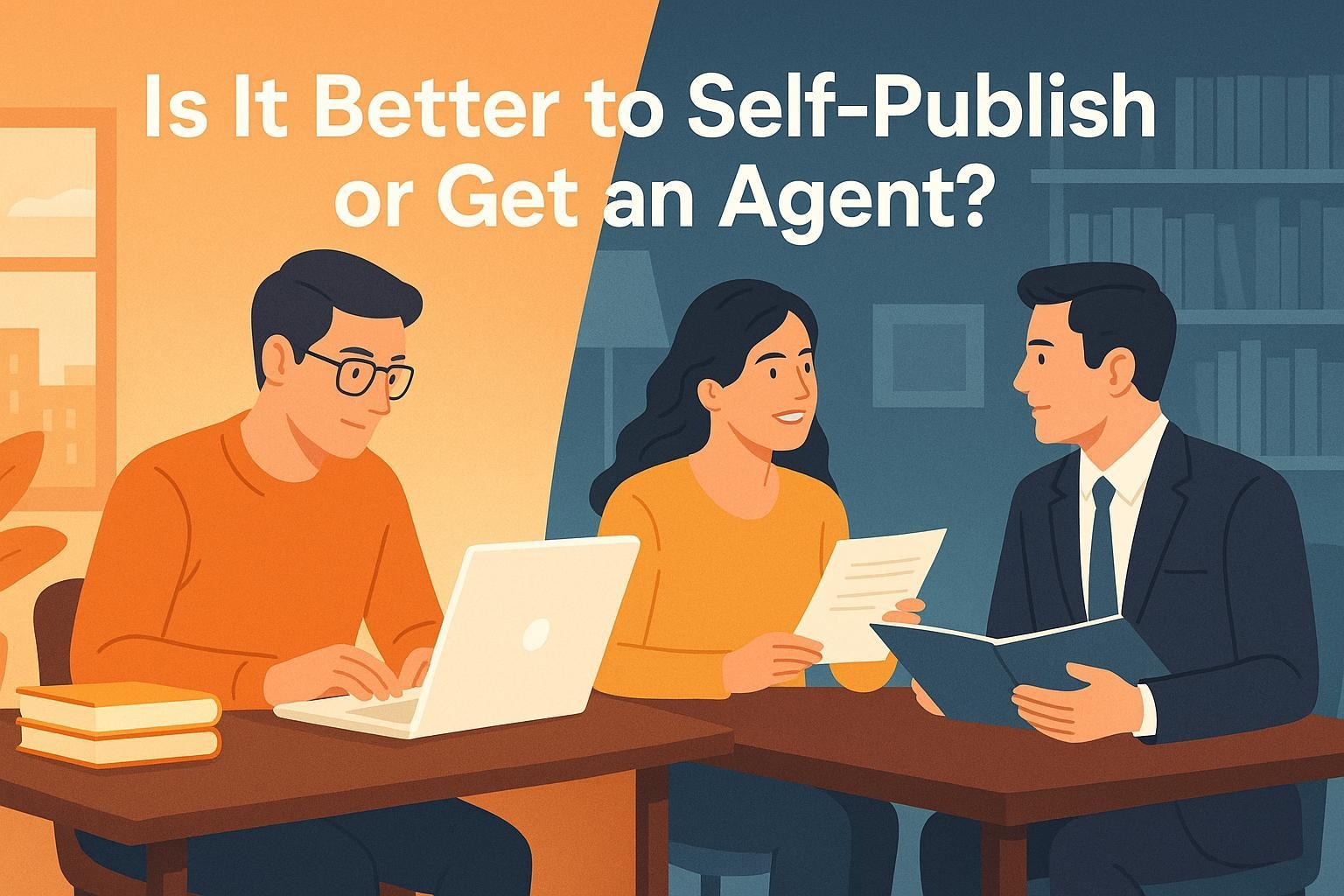
Trying to decide between self-publishing and getting a literary agent? This 2026 guide breaks down costs, timelines, royalties, and the exact path that fits your goals.
While writing a book is a daunting task on its own, publishing it is a whole other mountain to climb. With so many options available now, and so many exaggerated promises and “success stories”, you are too scared to make a choice between self publishing vs literary agent.
You’re not indecisive, you’re overwhelmed. Everyone online sounds certain. Friends give conflicting advice. Some people swear traditional publishing is the only “real” route. Others say indie is the future. Meanwhile, you’re caught between pride, practicality, and the very real desire to see your book in readers’ hands sooner rather than someday.
I’ve been in that headspace. It’s loud. It’s confusing. It makes you second-guess yourself in ways writing never did.
But here’s the good news: this guide will strip out the noise and replace it with clarity. You’ll see exactly how each route works and what it demands from you, what it gives back, and how it aligns with your goals, your genre, your timeline, and the way you want to run your writing career. By the end, you won’t just know the difference. You’ll know your direction.
Let’s get you there.
Big Picture: You’re Choosing a Business Model, Not Just a Path
Most writers don’t realize it at first, but the real choice you’re making isn’t emotional, it’s structural. You’re not simply choosing “self-publishing” or “traditional publishing.” You’re choosing how your book will function as a business and what role you will play inside that business.
That’s why researching for a reliable self publishing company or scrolling through agent wishlists can feel so overwhelming. You’re comparing two systems with totally different foundations, expectations, and rewards.
Self-publishing is an entrepreneurial model: you’re the CEO, the investor, and the creative visionary.
Traditional publishing is a partnership model: you hand the business reins to a publisher, and in return you gain infrastructure, distribution, and industry validation.
One path offers speed and control. The other offers prestige and support. Neither path is “right for everyone.” Each one is right for someone.
Your job now is figuring out which model fits the way you want to build your writing career.
What Getting an Agent Actually Involves
The Querying Phase
Getting a literary agent usually begins with querying. You research agents who represent your genre, study their preferences, and send a query letter with sample pages. This stage tests patience more than talent. Responses often take months. Silence is common. Rejections are frequent. A request for additional pages can feel like a major breakthrough because it means your work stood out in a crowded inbox.
What an Agent Actually Does
When an agent offers representation, the relationship becomes professional and strategic. An agent pitches your book to acquiring editors at traditional publishing houses. They negotiate advances, royalty rates, and contract terms. They also protect your rights and help prevent clauses that could limit your future work or income.
Beyond a single book, agents often think in terms of career building. They help you decide which projects to pursue next and how to position yourself within the market over time.
The Marketing Reality
One of the most common misconceptions is that an agent or publisher handles all marketing. In reality, authors are still expected to participate. You may be asked to grow an email list, maintain a social presence, or support launch efforts. Traditional publishing provides structure and access, but it does not remove the need for author visibility.
Selectivity and Market Fit
Agents are selective because publishers are selective. Strong writing alone is not always enough. Agents look for projects that align with current market demand and have a clear audience. Timing, genre trends, and positioning all matter. This means a well written book can still struggle to find representation if the market is not ready for it.
Time and Emotional Investment
Pursuing an agent requires emotional resilience. The process is slow and uncertain. From querying to submission to publication, years can pass. For some writers, that pace feels grounding and worthwhile. For others, it feels restrictive.
Choosing an agent is not choosing ease. It is choosing patience, professional guidance, and a traditional route that trades speed and control for access and industry expertise.
There Is No One Size Fits All Better
Why the Question Is Misleading
Asking whether self publishing or traditional publishing is better sounds reasonable. It feels logical. But it is the wrong question. There is no universal winner because authors are not all trying to win the same game.
Some writers want bookstore shelves and literary awards. Others want speed, control, and direct access to readers. Some want both, just not at the same time. When people argue about which path is better, they are usually arguing about different goals without realizing it.
Your Goals Change the Answer
The right choice depends on what you want your writing career to do for you. If you want institutional credibility, long term media access, and the validation that comes with a traditional imprint, an agent and publisher can make sense. If you want flexibility, faster releases, and higher income per book, self publishing may fit better.
Neither path is more serious. Neither path is more legitimate. They are simply designed for different outcomes.
Genre Matters More Than Ego
Genre plays a huge role in determining which path works best. Many commercial genres perform extremely well in self publishing because readers consume books quickly and buy in series. Literary fiction, memoir, and certain nonfiction categories often benefit from the editorial depth and distribution that traditional publishing offers.
Ignoring genre realities in favor of pride or fear often leads to frustration.
Resources and Personality Count
Some authors enjoy learning marketing, ads, and reader analytics. Others find that draining. Some thrive with full creative control. Others prefer collaboration and guidance. Your tolerance for risk, your budget, and your patience level all shape which option will feel sustainable over time.
The better path is the one you can stick with without burning out.
The Real Measure of Success
Success is not choosing the path that sounds impressive. It is choosing the path that supports your goals, your energy, and your long term vision. Once you see publishing as a set of tools rather than a hierarchy, the pressure to choose perfectly fades.
You are not choosing your worth. You are choosing your strategy.
How Traditional Publishing With an Agent Works
The Agent as Gatekeeper and Advocate
Traditional publishing begins with one crucial relationship. The literary agent. This person is your bridge into an industry that is largely closed to unrepresented writers. Editors at major publishing houses rely on agents to filter submissions, which means an agent does more than submit your book. They legitimize it in the eyes of the industry.
In the debate around self-publishing vs literary agent, this gatekeeping role is often misunderstood. It is not about superiority. It is about access. An agent knows which editors are buying what, who has room on their list, and how to position your book so it lands on the right desk at the right time.
Submission and the Long Road to a Deal
Once signed, your agent prepares your manuscript for submission. This may include revisions based on market feedback or positioning strategy. Then the book goes out to editors. Responses can take weeks or months. Some editors pass quietly. Others provide detailed feedback. Occasionally, interest leads to an offer or even an auction.
This phase requires patience and emotional endurance. Progress is often invisible until suddenly it is not.
Contracts, Advances, and Rights
If a publisher offers a deal, your agent steps fully into their advocate role. They negotiate the advance, royalty rates, and contract terms. This includes print, ebook, audio, and sometimes foreign or film rights. A strong agent works to protect your long term interests, not just the immediate payout.
Production and Beyond
After a deal is signed, the publisher handles editing, cover design, printing, and distribution. You are still involved, but you are not managing vendors. Traditional publishing gives you a team, a timeline, and access to bookstores and libraries that are difficult to reach independently.
It is a slower path. It is a structured path. And for the right author, it can be a powerful one.
Benefits of Going the Agent and Traditional Route
Credibility and Industry Access
One of the strongest advantages of traditional publishing is credibility. A recognized publisher opens doors that are difficult to access independently. Major media outlets, established review publications, award committees, and literary festivals are far more likely to pay attention when a book comes through traditional channels. That recognition still carries weight in many corners of the industry.
Professional Production Without Upfront Costs
Traditional publishing removes the financial burden of production from the author. Editing, cover design, interior layout, printing, and distribution are all funded by the publisher. You are not responsible for hiring vendors or managing workflows. This can be a relief for authors who want to focus on writing rather than project management or choosing a self-publishing company and coordinating freelancers.
Bookstore and Library Distribution
Print distribution remains a major strength of traditional publishing. Large publishers have established relationships with bookstores, libraries, and wholesalers. This makes it far easier for your book to appear on physical shelves across regions and countries. For authors who value in person discovery and institutional reach, this is a meaningful advantage.
Support and Career Structure
While authors are still expected to participate in marketing, traditional publishing provides structure and professional guidance. You work with editors who understand the market, publicists who manage outreach, and teams that have launched books before. This support does not guarantee success, but it does mean you are not navigating the process alone.
Traditional publishing is not faster or more flexible. But for authors seeking validation, scale, and professional backing, its benefits remain significant.
Downsides and Tradeoffs
The Reality of Slow Timelines
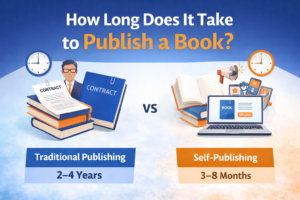
One of the biggest tradeoffs of traditional publishing is time. Lots of it. From querying agents to signing a deal, then from contract to publication, the process can easily stretch across several years. This delay can feel especially painful if your book is timely, trend driven, or tied to a specific moment in your life or career.
In the self-publishing vs literary agent debate, speed is one of the clearest dividing lines. Traditional publishing rewards patience, but it also demands it. If you thrive on momentum, this can feel suffocating rather than strategic.
Lower Earnings Per Book
Traditional publishing often means lower royalties. Print royalties are commonly in the single digits, while ebook royalties are usually a percentage of net revenue rather than list price. Even with an advance, many authors earn less per copy than they would through independent publishing.
Advances can also be misleading. They are paid in stages and must be earned out before additional royalties arrive. For many authors, that moment never comes. This does not mean traditional publishing is a financial failure, but it does mean the income model favors scale over margin.
Loss of Creative Control
When you sign with a publisher, you give up a degree of control. Covers, titles, pricing, and sometimes even editorial direction are ultimately decided by the publisher. You may have input, but not final say.
For authors deeply attached to their vision, this can be emotionally challenging. You might disagree with a cover choice or a marketing angle and still have to accept it. Collaboration can be rewarding, but it also requires flexibility and trust.
High Barriers to Entry
Before any of these tradeoffs even apply, you have to get in. Securing an agent is competitive. Many strong manuscripts never receive representation due to market timing, list saturation, or subjective taste. Rejection does not always reflect quality, but it still takes a toll.
Limited Marketing Guarantees
While traditional publishers offer marketing support, it is often modest unless your book is positioned as a major lead title. Most authors are expected to contribute significantly to promotion through events, outreach, and online presence. The myth of hands off marketing fades quickly once the book is released.
Traditional publishing offers structure and prestige, but it comes with real compromises. Knowing them upfront helps you decide whether the trade is worth it for you.
When Agents and Publishers Are a Stronger Fit
Projects That Rely on Institutional Support
Some books benefit deeply from institutional backing. Literary fiction, narrative nonfiction, memoir, and certain children’s books often rely on editorial depth, long development cycles, and access to traditional review outlets. These categories are still closely tied to publishers who know how to position books for critics, awards, and academic or cultural conversations.
If your work depends on prestige, curated visibility, or critical validation, traditional publishing offers infrastructure that is difficult to replicate independently.
Authors Who Value Team Based Collaboration
Traditional publishing suits authors who enjoy working within a structured team. Editors, designers, publicists, and sales departments all contribute to shaping the book’s journey. While you may not control every decision, you gain professional guidance from people who understand the market and have launched similar titles before.
For writers who feel energized by collaboration rather than drained by it, this environment can be both stabilizing and creatively satisfying.
Books Aimed at Bookstores and Libraries
Physical distribution remains a key strength of traditional publishing. Bookstores and libraries often prefer to work with top book marketing services due to return policies, discounts, and existing supply chains. If seeing your book on shelves matters deeply to you, this path offers the most reliable access.
This also matters for authors who plan to speak at schools, universities, or institutions where traditional distribution still carries weight.
Writers Who Prefer Lower Financial Risk
Traditional publishing shifts financial risk away from the author. You are not paying for editing, design, or printing upfront. While this means lower royalties later, it also means you are not investing large sums before seeing results.
For authors without the budget or desire to manage freelancers, this model can feel safer and more sustainable.
Careers Built on Long Term Visibility
Some writing careers are not built on speed or volume. They are built slowly through reviews, awards, speaking engagements, and reputation. Traditional publishing supports this long arc approach. It favors fewer books released with more institutional backing rather than rapid output.
Agents and publishers are not the best fit for every author. But for the right goals, genres, and personalities, they remain a powerful option.
How Self Publishing Works and Who It Serves Best
The Modern Self Publishing Ecosystem
Self publishing today is not a fringe option. It is a mature ecosystem supported by global platforms and professional services. Authors publish through retailers like Amazon KDP, Kobo, and Apple Books, while print distribution often runs through services such as IngramSpark. These platforms make it possible for a single author to reach readers worldwide without a traditional gatekeeper.
Many writers also work with freelancers who previously worked inside publishing houses. Editors, cover designers, and formatters often move between traditional and independent projects. In practice, the quality gap between traditional publishing and a well run self publishing company has narrowed dramatically.
Speed and Flexibility
One of the clearest advantages of self publishing is speed. Once your manuscript is ready, you can publish within weeks or months rather than years. This flexibility allows authors to respond quickly to market trends, reader feedback, or personal goals.
You control the release date, pricing, and updates. If something is not working, you can change it. That level of adaptability is rare in traditional publishing and deeply appealing to writers who value momentum.
Creative and Strategic Control
Self publishing gives you full authority over your book. You choose the cover, the title, the blurb, and the overall positioning. You decide how the book fits into a series or brand. This control allows you to align creative vision with business strategy rather than negotiating between the two.
For some authors, this freedom feels empowering. For others, it feels intimidating. The difference often comes down to personality and comfort with decision making.
Higher Royalties and Direct Reader Connection
Royalty rates in self publishing are significantly higher than in traditional deals. This means fewer sales can generate meaningful income. You also gain direct access to reader data through reviews, mailing lists, and platform dashboards.
This connection helps authors learn what readers respond to and adjust future books accordingly.
Who Thrives in Self Publishing
Self publishing often serves genre fiction writers, niche nonfiction authors, and fast moving creators who treat writing as an entrepreneurial venture. It rewards experimentation, consistency, and a willingness to learn business skills alongside craft.
For the right author, it offers freedom, scalability, and long term control over a creative career.
Advantages of Self Publishing
Speed That Matches Modern Publishing
One of the most powerful advantages of self publishing is how quickly you can move from manuscript to marketplace. Once your book is edited and designed, you control the timeline. There is no waiting for seasonal catalog slots or internal approvals. This speed allows authors to publish while ideas are still fresh and readers are still searching for them.
In the conversation around self-publishing vs literary agent, speed often becomes the deciding factor for authors who do not want their work sitting in limbo for years.
Full Creative Control
Self publishing gives you authority over every creative decision. You choose your cover, title, pricing, and positioning. If something does not work, you can change it. That level of control is rare in traditional publishing, where final decisions often rest with the publisher.
For many authors, this freedom is deeply motivating. It allows creative vision and business strategy to move in the same direction rather than competing with each other.
Higher Royalties Per Book
Independent authors earn a much larger share of each sale. Ebook royalties can reach seventy percent on major platforms, and print margins are often significantly higher than traditional deals. This means fewer sales are required to generate meaningful income.
While traditional publishing relies on volume and scale, self publishing rewards efficiency and audience alignment.
Strength in Genre and Niche Markets
Certain genres thrive in self publishing. Romance, fantasy, science fiction, thrillers, and other commercial categories often perform exceptionally well. Readers in these spaces consume books quickly and value series, which aligns perfectly with the independent model.
Niche nonfiction also benefits. If you serve a specific audience, self publishing allows you to reach them directly without needing mass market appeal.
Direct Relationship With Readers
Self publishing gives you access to reader data and feedback. Reviews, email lists, and sales dashboards help you understand what resonates. This direct connection allows authors to improve future books and build loyalty over time.
For writers who want ownership, agility, and long term control, self publishing offers advantages that continue to compound with every release.
Challenges of Self Publishing
Upfront Financial Investment
One of the first realities of self publishing is cost. To produce a professional book, you need editing, cover design, and formatting. These are not optional if you want readers to trust your work. Unlike traditional publishing, you pay for these services before the book ever earns a dollar.
This investment can feel risky, especially for first time authors. There is no guaranteed return, and results vary widely based on quality, genre, and marketing.
Marketing Becomes Your Responsibility
Publishing the book is only the beginning. Visibility is the real challenge. In self publishing, you are responsible for finding readers and convincing them to care. That often means learning advertising platforms, building an email list, and staying active where your audience spends time.
This part overwhelms many writers. Marketing requires consistency and experimentation. What works for one book or author may not work for another.
Quality Control Is on You
Without gatekeepers, the responsibility for quality rests entirely on the author. This includes writing, editing, presentation, and brand consistency. A poorly edited book or amateur cover can damage reader trust quickly.
Self publishing rewards high standards. It also punishes shortcuts.
The Mental Load of Running Everything
Self publishing turns authors into managers. You make decisions, track results, and solve problems that arise along the way. For some writers, this is exciting. For others, it drains creative energy.
Balancing creativity with business tasks is one of the hardest parts of the independent path.
No Built In Validation
There is no external approval stamp in self publishing. Success is measured by readers, sales, and reviews rather than institutional recognition. For authors who crave validation from the industry, this absence can feel uncomfortable.
Self publishing offers freedom, but it also demands ownership of every outcome, good or bad.
When Self Publishing Is Often the Better Fit
Authors With Clear Target Audiences
Self publishing works best when you know exactly who your readers are. If your book serves a specific genre community or a clearly defined niche, independent publishing allows you to reach those readers directly. You do not need to convince a publisher that your audience exists. You only need to connect with them.
In the self-publishing vs literary agent discussion, this clarity around audience often shifts the balance toward independence.
Writers Who Value Speed and Momentum
If waiting years to publish feels unbearable, self publishing offers relief. You can release your book on your timeline, build momentum quickly, and learn from real world feedback. This is especially valuable for authors who plan to write multiple books or series and want to maintain consistent visibility.
Momentum compounds. Each release supports the next.
Entrepreneurial and Business Minded Creators
Self publishing favors authors who are comfortable making decisions and learning business skills. Pricing strategies, advertising experiments, and reader analytics are part of the process. While this can feel intimidating at first, it also gives authors direct insight into what works.
Writers who enjoy testing ideas and adapting quickly often thrive in this environment.
Genre Fiction and Commercial Categories
Many commercial genres perform exceptionally well in self publishing. Romance, fantasy, thrillers, and science fiction often attract voracious readers who value frequent releases and series continuity. These genres benefit from the flexibility and higher royalties of independent publishing.
Traditional publishing still participates in these genres, but independent authors often move faster and respond more directly to reader demand.
Authors Building Brands or Businesses
Self publishing pairs well with broader business goals. Coaches, consultants, and creators who use books to support speaking, courses, or services often benefit from full control over content and distribution. The book becomes an asset that integrates seamlessly into a larger brand.
Writers Who Want Ownership Long Term
Self publishing allows authors to retain rights, update content, and relaunch books as markets change. This long term control appeals to writers who view their work as a growing catalog rather than a one time release.
For the right author, self publishing is not a compromise. It is a strategic advantage.
Key Questions to Decide Agent or Self Publish
What Are You Really Trying to Achieve
Before comparing contracts or platforms, get honest about your goals. Do you want awards, reviews, and bookstore placement, or do you want speed, control, and income flexibility. Neither goal is better, but they lead to very different decisions.
Most confusion around publishing choices comes from unclear priorities rather than lack of information.
Who Is Your Audience and Where Do They Buy Books
Some readers live in bookstores and libraries. Others discover books through online retailers, social media, and email lists. Your genre and audience behavior matter more than abstract ideas of legitimacy.
If your readers buy quickly, read frequently, and follow authors online, self publishing often aligns well. If your audience depends on institutional access, traditional publishing may offer advantages.
How Comfortable Are You With Business and Marketing
Every author markets their work, regardless of path. The difference is how much responsibility you carry. Self publishing requires hands on involvement with pricing, ads, and promotion. Traditional publishing still expects effort, but with more guidance and structure.
Ask yourself whether learning these skills feels energizing or exhausting. The answer matters.
What Is Your Timeline
Time tolerance is a practical but emotional factor. If you want your book available within a year, self publishing is the realistic option. If you are willing to spend years querying, submitting, and waiting for release dates, traditional publishing becomes possible.
Neither timeline is wrong. One may simply fit your life better.
What Is Your Budget and Risk Tolerance
Self publishing requires upfront investment with uncertain return. Traditional publishing shifts financial risk to the publisher but limits your upside through lower royalties and less control.
Consider what kind of risk you can handle without resentment. Financial stress can poison a creative process just as easily as creative frustration.
How Do You Handle Rejection and Uncertainty
Querying agents often involves long periods of silence and rejection. Self publishing moves faster but places all decision making on your shoulders. One path tests patience. The other tests confidence.
There is no painless option. There is only the option you can sustain.
Choosing how to publish is not about choosing a side. It is about choosing a system that supports your goals, energy, and long term vision as a writer.
Hybrid Paths and Switching Strategies
Starting With Self Publishing to Prove Demand
Many authors begin independently not because they reject traditional publishing, but because they want proof. Sales data, reviews, and reader engagement tell a story that is difficult to ignore. A book that performs well on its own demonstrates market demand in a way that pitches and proposals cannot.
Working with a self publishing company or managing the process yourself allows you to gather real world evidence. This data can later strengthen conversations with agents who are interested in projects with demonstrated traction.
Attracting Agents After Independent Success
Strong independent performance can change the dynamic of agent outreach. Instead of asking for permission, you are presenting results. Agents may reach out directly when a book shows momentum or media interest.
This route works especially well for authors in commercial genres or nonfiction writers with growing audiences. Success does not need to be massive. Consistent sales, strong reviews, and visible growth are often enough to spark interest.
Traditional First, Independent Later
Some authors start traditionally and move into self publishing later. A traditionally published book can offer credibility, editorial experience, and exposure that carries into future projects. Once that foundation is set, independent publishing offers greater control and higher long term earnings.
This approach allows authors to benefit from both systems without committing to only one.
Splitting Rights and Formats
Hybrid publishing does not always mean switching entirely. Some authors sell print rights traditionally while keeping digital or audio rights. Others license foreign rights while maintaining control of domestic editions.
This flexibility allows authors to tailor each project to its strengths rather than forcing every book into the same model.
Building a Career, Not Choosing a Side
Hybrid paths acknowledge a simple truth. Publishing is not static. Markets change. Goals evolve. What works for one book may not work for the next.
The most sustainable careers are often built by authors who remain flexible, strategic, and willing to adapt. Hybrid publishing is not indecision. It is intentional design.
Myths, Misconceptions, and Red Flags
Myth: Self Publishing Is a Last Resort
One of the most persistent myths is that authors self publish only because they could not get a traditional deal. That idea is outdated. Many writers actively choose independence because it aligns better with their goals, genre, or income expectations.
Today, self publishing is often a strategic decision, not a fallback. Some independent authors earn more than traditionally published midlist writers and maintain full control over their careers.
Myth: An Agent Will Handle Everything for You
Signing with an agent does not mean you are done working. Agents pitch books and negotiate contracts, but they do not run your marketing or build your audience. Even traditionally published authors are expected to participate heavily in promotion.
Believing that representation equals visibility often leads to disappointment. Publishing is a partnership, not a handoff.
Myth: Once You Choose a Path, You Are Stuck
Publishing is not a one time decision. Authors move between models all the time. Some publish one book traditionally and the next independently. Others sell certain rights while keeping others.
Choosing a path now does not lock you in forever. It simply determines your next step.
Red Flag: Anyone Asking for Upfront Fees
Legitimate agents do not charge reading fees. Traditional publishers do not ask authors to pay for publication. Any agent or publisher requesting upfront payment should be approached with extreme caution.
Money should flow to the author in traditional publishing, not away from them.
Red Flag: Vague Hybrid Offers
Some companies label themselves as hybrid publishers but offer little transparency. High fees, unclear deliverables, and vague promises of marketing or distribution are warning signs.
If services are not clearly defined and priced, walk away.
Red Flag: Guaranteed Success Claims
No one can guarantee bestseller status, media coverage, or sales numbers. Publishing is unpredictable by nature. Anyone promising certainty is selling hope, not results.
Why These Myths Matter
Believing myths can push authors into choices driven by fear rather than strategy. Recognizing red flags protects both your finances and your creative energy.
The more clearly you see the industry, the more confidently you can move through it.
If You Want an Agent: A Step by Step Roadmap
Polish the Manuscript First
Before you query anyone, your manuscript needs to be finished and revised thoroughly. This is not the time for placeholders or half resolved scenes. Many authors benefit from beta readers or professional editing to identify weaknesses they can no longer see themselves.
Research the Market Carefully
Agents want to know where your book fits. Study comparable titles, understand your genre expectations, and identify agents who represent similar work. Targeting matters more than volume.
Build a Strong Query Package
Your query letter should clearly explain what your book is about, who it is for, and why it stands out. Follow each agent’s submission guidelines exactly. Small mistakes signal carelessness.
Query Strategically and Patiently
Send queries in batches rather than all at once. Track responses and look for patterns. Silence and rejection are part of the process.
In the self-publishing vs literary agent decision, this stage often reveals how much patience you truly have.
Evaluate Offers Thoughtfully
If you receive an offer, ask questions. Discuss communication style, submission plans, and long term career vision. This is a partnership, not a favor.
If You Self Publish: A Step by Step Roadmap
Treat the Book Like a Product
Self publishing works best when you approach it strategically. Before you upload anything, define your target reader, the promise your book makes, and how it stands out in the market. Clear positioning makes every later decision easier.
Budget for Professional Essentials
Quality matters. At a minimum, plan for developmental editing or a manuscript assessment, followed by copyediting and proofreading. A professional cover design is not optional. Readers judge books quickly, and presentation influences trust.
Set Up Publishing Accounts and Metadata
Choose your platforms and formats, including ebook, paperback, hardcover, or audio. Pay close attention to categories, keywords, pricing, and descriptions. These details affect discoverability more than most authors expect.
Plan a Simple Launch
You do not need a massive campaign. Focus on early reviews, advance reader copies, and reaching your existing audience through email or social media. Consistency matters more than scale.
Optimize After Release
Publishing is not a one time event. Monitor reviews and sales data, test pricing, adjust blurbs, and refine categories. Small changes over time can lead to significant improvements.
Self publishing rewards authors who stay engaged after launch and treat publishing as an ongoing process rather than a finish line.
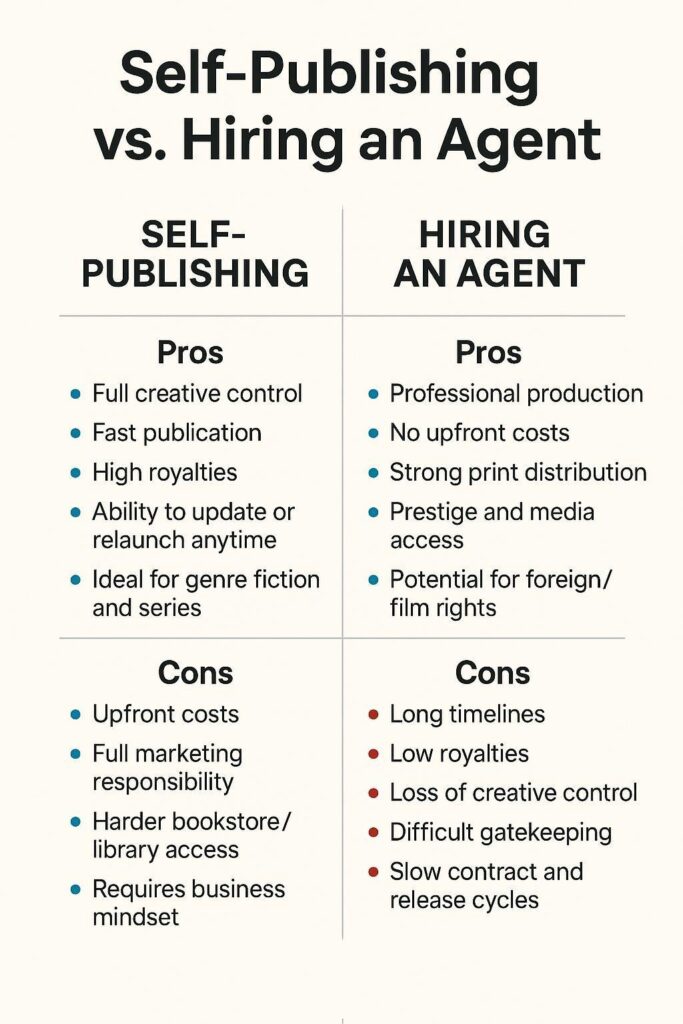
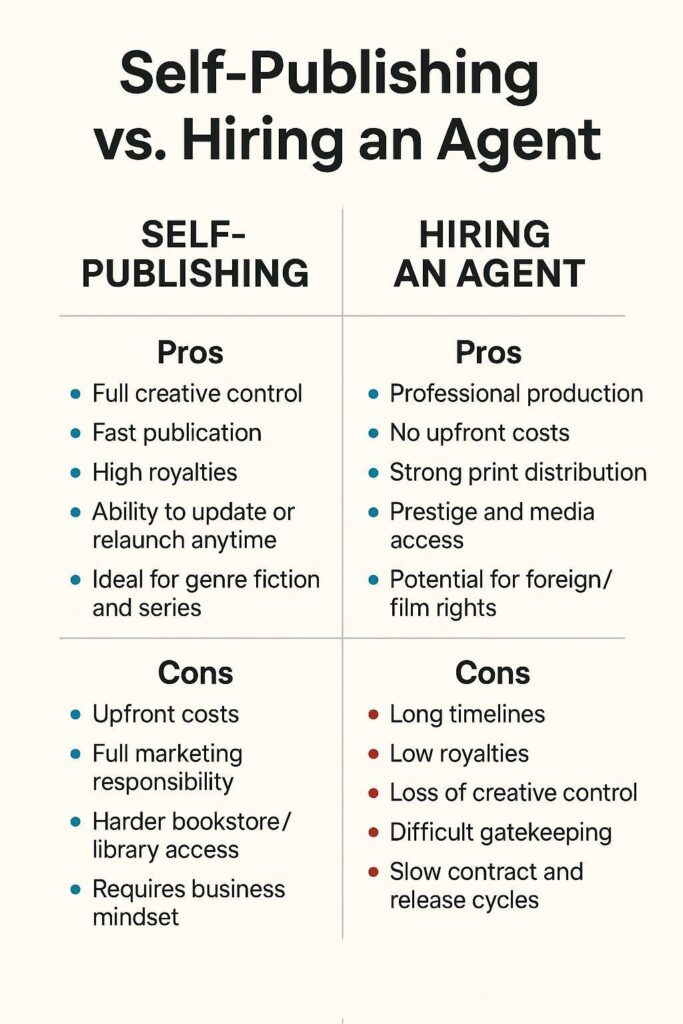
Pros and Cons Comparison
Self Publishing Pros
- Full creative control over cover, title, pricing, and release schedule
- Fast publication once the manuscript is ready
- Higher royalties per book compared to traditional deals
- Ability to update, revise, or relaunch at any time
- Ideal for genre fiction, series, and niche audiences
Self Publishing Cons
- Upfront costs for editing, design, and formatting
- Financial risk before the book earns income
- Full responsibility for marketing and promotion
- Limited access to physical bookstores and libraries
- Requires a business mindset, including budgeting and analytics
Traditional Publishing Pros
- No upfront production costs for editing, design, or printing
- Strong print distribution through bookstores and libraries
- Greater access to media coverage, awards, and review outlets
- Professional book editors, as well as teams for design and sales
- Potential support for foreign, film, and subsidiary rights
Traditional Publishing Cons
- Long timelines from submission to publication
- Lower royalties per book
- Reduced creative control over cover and pricing
- High barriers to entry and intense gatekeeping
- Slow contract negotiations and release schedules.
FAQs
Is It Easier to Get an Agent After Self Publishing
It can be easier if your book performs well. Strong sales, consistent reviews, or visible audience growth give agents concrete proof of market demand. If a self published book shows little traction, it usually does not offer an advantage and may even raise questions.
How Many Sales Impress an Agent
There is no fixed number. Several thousand paid sales, steady momentum over time, or strong engagement within a niche can make a difference. Agents look for patterns rather than one time spikes.
Which Path Earns More Money
Self publishing often earns more per book due to higher royalties. Traditional publishing income depends on advances, print distribution, and long term sales. Some authors earn more traditionally, but many do not earn beyond their advance.
Can I Query Agents While Preparing to Self Publish
Yes, as long as you do not publish the manuscript while it is under active consideration. Transparency matters. If you plan to self publish by a certain date, communicate that clearly.
Do Traditional Publishers Market My Book
Yes, but the level of support varies. Most authors are still expected to participate in promotion through newsletters, social media, events, or outreach. Marketing is a shared responsibility.
Is Hybrid Publishing the Same as Self Publishing
No. Hybrid publishers charge fees for services and vary widely in quality and transparency. Some provide legitimate value, while others rely on vague promises. Careful research is essential.
Do I Lose Rights in Traditional Publishing
You license specific rights for a set period of time. A good agent negotiates fair terms and ensures rights revert back to you when conditions are met.
Conclusion
Choosing between self publishing and traditional publishing is not about right or wrong. It is about alignment. Your goals, genre, resources, and personality matter more than industry noise. Some authors thrive with control, speed, and ownership. Others value structure, distribution, and institutional credibility. Many build successful careers by combining both paths over time.
The real mistake is choosing based on fear or prestige rather than strategy. Once you understand the tradeoffs, the decision becomes clear.
The self-publishing vs literary agent question is not a test. It is an opportunity to design a career that actually fits you.