Wondering if your favorite celebrity actually wrote their memoir or that heartfelt Instagram note? This guide breaks down how ghostwriting works, why it’s everywhere, and what’s really honest (or not) about it.
Introduction
You know that moment when you pick up a celebrity memoir or read a deeply emotional Instagram caption and think, There is no way they wrote this themselves? That spark of doubt is more common than you think. Many readers feel confused, curious, or even a little misled when they hear people talk about celebrity ghostwriters, and they want someone to finally explain what is real.
Here is what most people overlook. Writing a book or even a long, heartfelt post takes time, emotional clarity, and real storytelling skill. Most celebrities are constantly traveling, filming, rehearsing, performing, or showing up for brand commitments. Writing is not their main job, and it is rarely something they have hours to pour into. Still, the uneasy feeling you get makes sense. You want authenticity. You want the voice on the page to actually sound like the person you admire.
I have spent years digging into how the publishing world really operates, and ghostwriting is not a scandal. It is a system with its own workflow, expectations, and ethics. In this article, you will learn how often celebrities use ghostwriters, why they rely on them, what kinds of projects involve outside writers, how the collaboration works behind the scenes, and the signs that help you spot a ghostwritten book.
By the end, you will not just have an answer. You will understand the entire ecosystem and what it means for the books, speeches, and posts you read every day.
What Is a Ghostwriter, Exactly?
1. Definition and Role
A ghostwriter is a writer who creates content that someone else publicly takes credit for. In celebrity publishing, this can mean anything from writing an entire memoir to shaping a rough draft into something readable. Some writers work completely behind the scenes, while others appear on the cover with a small “with” credit. Either way, the goal is simple. The writer captures the celebrity’s voice, organizes their stories, and turns ideas or memories into a finished piece of writing.
There are a few different levels of collaboration you might see:
Full Ghostwriting
The ghostwriter writes the entire manuscript based on interviews, research, and direction from the celebrity. The celebrity’s name is the only one on the cover.
Co-writing or “With” Credit
Both names appear on the cover. This is more transparent and often used when the celebrity wants to acknowledge the help without giving up primary authorship.
Editing or Book Doctoring
The celebrity writes a draft, and the editor reshapes it into a polished, structured, coherent book. The editor may stay anonymous or receive a thank-you in the acknowledgments.
Each version is normal within the industry, and each one supports the same goal: telling the story clearly, authentically, and in the celebrity’s voice.
2. Where Ghostwriters Show Up in Celebrity Work
Ghostwriters do far more than memoirs. You will find professional ghost writers shaping all kinds of celebrity content, including:
Books
- Memoirs and autobiographies
- Lifestyle books related to food, fitness, fashion, wellness, or parenting
- Business and leadership books
- Fiction based on a celebrity’s concept or brand
Articles and Op-Eds
Long-form pieces in major magazines and newspapers often come from interviews that are later crafted by a writer.
Speeches and Statements
Award show monologues, campaign speeches, TED-style talks, and crisis statements are frequently written with professional help.
Digital Content
Newsletters, social media posts, fan letters, and blog posts often go through writers or content teams, especially for major influencers or celebrities with busy schedules.
3. A Quick Note on Confidentiality
Ghostwriters typically sign confidentiality agreements. These NDAs protect the celebrity’s privacy and keep the collaboration private unless both parties agree to be open about it. This is why you rarely hear the full story unless the ghostwriter or celebrity chooses to share it.
How Common Is Ghostwriting in Celebrity Publishing?
1. Industry Estimates and Why Hard Numbers Are Tricky
If you ask people inside publishing how often celebrities use ghostwriters, the answer is usually some version of “more often than you think.” Although exact numbers are difficult to confirm because of nondisclosure agreements, industry insiders consistently estimate that a large percentage of celebrity memoirs are ghostwritten or heavily co-written. The same is true for many business and lifestyle books tied to public figures.
Why is it so hard to pin down exact data? Confidential contracts, private agreements, and uncredited collaborations make the numbers fuzzy. Ghostwriting is designed to be invisible unless both sides choose to shine a light on it.
What we do know is this: when a celebrity releases a polished, emotionally layered, commercially strong book, there is almost always a professional writer behind the scenes helping shape the final product.
2. Why Celebrity Publishing Relies on Ghostwriters
Ghostwriters are standard in the industry for a few key reasons:
Tight Schedules
Celebrities move from project to project with almost no downtime. Writing a thoughtful book takes months. Most simply do not have that window.
Writing Is Its Own Skill
Performing is a skill. Running a business is a skill. Playing a sport at a world-class level is a skill. Writing a compelling narrative is a completely different discipline. This is why even talented, intelligent celebrities often rely on outside help.
Publisher Investment in the Celebrity’s Name
A publisher buys the celebrity’s story and brand, but they still need the final product to be strong enough to sell. Pairing the celebrity with a skilled writer or someone who can offer affordable book editing ensures quality without sacrificing authenticity.
3. Evidence from Insiders and Trade Conversations
Agents, editors, and ghostwriters themselves speak openly about how common ghostwriting is. Trade publications like Publishers Weekly, The Guardian, and various writing-focused podcasts have featured interviews where writers describe the process, the confidentiality, and the sheer number of celebrity projects that depend on ghostwriters.
If you have ever wondered whether ghostwriting is unusual, the publishing world would answer clearly. It is not unusual at all. It is normal, routine, and widely accepted.
Famous Examples: Which Celebrity Books Were Ghostwritten?
1. Celebrity Memoirs with Known Ghostwriters
Some of the most successful celebrity memoirs were shaped with the help of professional writers. These collaborations are not always hidden. In some cases, the ghostwriter becomes part of the public conversation because the book’s voice is so strong or the partnership is openly acknowledged.
Here are a few well known examples:
- Prince Harry’s Spare written with JR Moehringer
- Demi Moore’s Inside Out shaped by Ariel Levy
- Donald Trump’s The Art of the Deal written by Tony Schwartz
These writers helped structure the story, refine the voice, and craft a narrative that resonated with millions of readers. Their involvement shows how common and accepted high profile partnerships are in the publishing world.
2. Other Public Figures and Brand Name Authors
Ghostwriting reaches far beyond actors and musicians. Politicians, athletes, CEOs, influencers, and other public figures often use professional writers to help shape their books. Many political memoirs, thought leadership titles, and lifestyle books are written through extensive interviews that become the foundation for a polished manuscript.
Some of these writers appear on the cover. Others stay behind the scenes. Either way, the goal remains the same. The book must reflect the public figure’s message and personal tone even if the writing itself is handled by someone else.
3. Transparent Collaborations vs. Hidden Ones
Not every partnership looks the same. You will see a few different models:
On the Cover
A “with” credit or a shared byline appears directly under the celebrity’s name.
In the Acknowledgments
The ghostwriter is thanked personally for shaping the book, usually with language like “helping me find my voice” or “turning hours of conversations into a story.”
Completely Anonymous
Some agreements keep the writer entirely invisible. These are common when the celebrity or publisher wants the main name to stand alone.
Whether open or private, these collaborations reflect an industry where high quality storytelling is often a team effort. Behind many bestselling celebrity books, you will find celebrity ghostwriters who lift the story, clarify the message, and help bring the book to life.
Why Do Celebrities Use Ghostwriters?
Celebrities use ghostwriters for reasons that are practical, emotional, and sometimes deeply strategic. The choice is not about laziness. It is about creating a book or message that actually works. Behind almost every polished memoir or confident leadership title, there is a team shaping the voice, the structure, and the story. This is where celebrity ghostwriters often play a central role.
1. Time and Workload
Most celebrities live on tight, inflexible schedules. They travel constantly, appear at events, shoot films or shows, rehearse, train, record, or manage businesses. Writing a book requires long stretches of focused time, and that kind of space rarely exists in a celebrity’s calendar. A ghostwriter steps in to manage the heavy lifting. They conduct interviews, review research, shape chapters, and create drafts while the celebrity continues with their career. This partnership allows a book to get written without disrupting filming, touring, or promotional cycles.
2. Skill and Quality Control
Writing is not something you casually pick up because you are famous. It is a craft. It requires structure, pacing, clarity, emotional awareness, and the ability to keep a reader turning the page. Even the most articulate celebrities may not know how to translate personal stories into a strong narrative. Ghostwriters bring the technical skill. They organize scattered memories, highlight key moments, build tension, and offer a clear arc from beginning to end. Publishers rely on this because a book tied to a major name still needs to meet professional standards.
3. Brand Management
Every public figure has a brand. A book becomes part of that brand, so the tone has to match the image the celebrity wants to protect. Ghostwriters help align the voice with the public persona. They write in a way that feels familiar to fans. They avoid legal risks, clarify complicated topics, and make sure the book supports the celebrity’s long term image. In industries where reputations shift quickly, that kind of guidance is essential.
4. Complex or Sensitive Stories
Memoirs often include trauma, loss, addiction, recovery, scandal, and private moments that are difficult to talk about, let alone write about. Ghostwriters know how to handle emotional material with care. They listen, ask precise questions, and translate painful experiences into stories that feel honest while still maintaining the boundaries the celebrity needs.
5. Different Formats Require Different Skills
A memoir is not the same as a cookbook. A cookbook is not the same as a leadership book. A leadership book is not the same as a novel. Each one requires a specific writing approach. Ghostwriters understand these differences, which allows a celebrity to produce a book that fits the genre instead of guessing their way through it.
What Kinds of Celebrity Content Are Ghostwritten?
Ghostwriting in celebrity culture is far more widespread than most people realize. Many readers imagine ghostwriters only stepping in for memoirs, but the truth is much broader. If a piece of celebrity content is polished, strategic, emotionally sharp, or delivered with careful timing, a professional writer probably had a hand in shaping it. The work of the best memoir writers for hire often extends into multiple formats, which is why their influence appears in books, speeches, digital content, and even quick promotional messages. Ghostwriting is not a single role. It is an ecosystem that supports a celebrity’s voice across every channel where that voice needs to sound clear, consistent, and intentional.
1. Books
Books remain the most common place where ghostwriters contribute. The range of book types is wide, and each one presents its own challenges.
Memoirs and Autobiographies
Memoirs require emotional depth, narrative structure, and a sense of pacing. A celebrity may have powerful stories, but turning those stories into a compelling book takes hours of interviews, careful listening, and detailed drafting. Ghostwriters organize memories, identify themes, shape character arcs, and create a story that reads smoothly from first page to last.
Lifestyle Books
Many celebrities release books on cooking, fitness, wellness, fashion, beauty, or parenting. These books demand clarity, accuracy, and a conversational tone. A ghostwriter helps turn expert advice or personal habits into chapters that are easy to follow and enjoyable to read. They also make sure the content fits the celebrity’s brand and target audience.
Business and Leadership Books
Entrepreneurs, CEOs, and influencers often want to share lessons or frameworks from their careers. Writing a business book requires structure, strategy, and precise explanations. Ghostwriters interview the celebrity, gather examples, and shape the content into clear takeaways and actionable insights.
Fiction Based on Celebrity Concepts
Some celebrities have creative ideas they want to turn into novels. They might imagine characters or storylines, but writing fiction requires a different skill set. Ghostwriters build the world, create dialogue, develop plot twists, and shape the final manuscript while staying loyal to the celebrity’s concept.
2. Short Form Content
Not every ghostwritten project becomes a full length book. Many celebrities publish shorter pieces that still require a professional touch.
Articles and Essays
Major magazines and newspapers often feature personal essays, opinion pieces, or interviews written with the help of a ghostwriter. These pieces need to capture the celebrity’s voice quickly, which requires a writer who understands tone, pacing, and emotional impact.
Forewords and Introductions
Celebrities are frequently asked to write forewords for other authors’ books. A ghostwriter helps craft a strong opening that honors the book while sounding like it genuinely came from the celebrity.
3. Speeches and On Stage Material
Award show scripts, charity gala speeches, TED style talks, political events, and even late night segment notes often involve ghostwriters. Speaking naturally in front of a crowd takes practice, but writing that speech in the first place requires clarity, humor, and timing. A ghostwriter helps the celebrity sound confident, polished, and sincere.
4. Digital Presence
Digital communication is constant, and many celebrities rely on writers to keep their online voice consistent. This includes:
- Social media captions
- Long form posts
- Personal letters to fans
- Email newsletters
- Branded blog content
With busy schedules and high public expectations, maintaining a steady digital presence is difficult. Ghostwriters help keep everything aligned, thoughtful, and on brand, even when the celebrity is traveling or focused on other projects.
Is It Ethical for Celebrities to Use Ghostwriters?
The ethics of ghostwriting can feel complicated. Some readers see it as a harmless collaboration. Others feel uneasy when they discover a book or speech was shaped by someone they never heard of. The truth sits somewhere in the middle, and understanding it requires a clear look at how the industry works, what readers expect, and why celebrities choose to partner with professional ghost writers in the first place.
1. Legal Versus Ethical Considerations
Ghostwriting is completely legal. Contracts define the rights, expectations, confidentiality terms, and payment structure. As long as both parties honor the agreement, nothing about the arrangement violates the law. The ethical questions come from perception. Readers often assume a book with a celebrity’s name on it is written entirely by that person. When that turns out not to be true, some people feel misled. The tension is not legal. It is emotional.
2. Arguments in Favor of Ghostwriting
Ghostwriting has a long history in creative industries. Music has songwriters. Film has screenwriters. Politics has speechwriters. Collaboration is normal. Supporters argue that the value of a memoir or leadership book comes from the story, not from who typed each sentence. They also point out that many powerful stories would never reach the public without a skilled writer shaping them. When a ghostwriter helps someone express a story they would otherwise struggle to articulate, that partnership can be seen as generous and necessary.
3. Criticisms and Concerns
Not everyone sees ghostwriting positively. Critics worry it creates a sense of deception, especially in memoirs or advice books. A memoir feels personal, so readers expect the writing to come directly from the person who lived the story. If a reader discovers a hidden writer, they sometimes question the authenticity of the entire book. This concern becomes stronger when the book involves trauma, recovery, grief, or sensitive emotional experiences. People want to feel close to the celebrity. A hidden writer can feel like a barrier.
4. The Push for More Transparency
In recent years, more people inside publishing have called for greater transparency. Some authors, agents, and writing organizations argue that clear credit helps maintain trust. Options include adding a “with” credit on the cover, including a visible byline, or offering explicit acknowledgment inside the book. When readers understand the collaboration, they can appreciate the story without feeling misled. Transparency keeps the relationship honest and protects the integrity of the book.
How Celebrity–Ghostwriter Collaborations Actually Work
Most people imagine ghostwriting as a mysterious process, but the reality is surprisingly structured. Celebrity books are built through a clear workflow, steady communication, and a team effort that blends the celebrity’s experiences with a writer’s technical skill. Whether the project is a memoir, a lifestyle book, or a business title, the collaboration follows a predictable rhythm that keeps the story honest and the writing professional. Even when a project involves research teams, editorial staff, or affordable book editing, the heart of the story still comes directly from the celebrity.
1. Typical Workflow
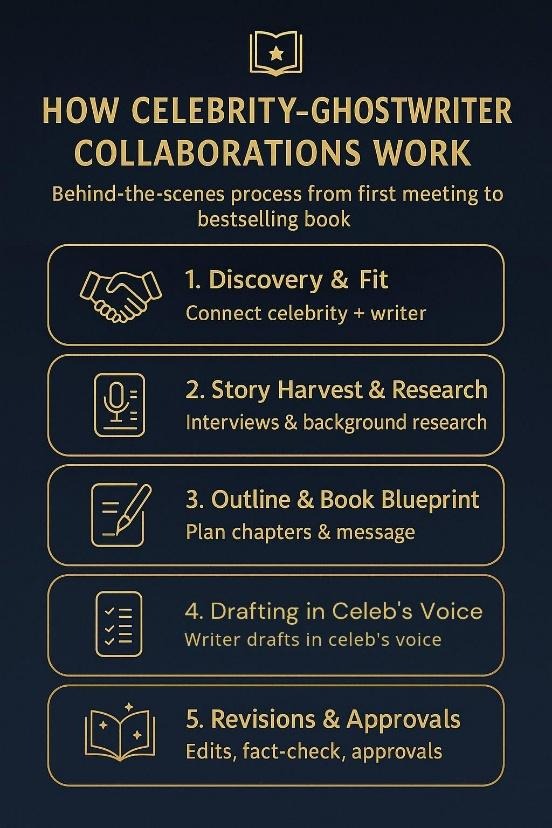
Every project begins with a foundation. The ghostwriter and celebrity meet to discuss the big picture. The writer asks about themes, career milestones, emotional turning points, and the message the celebrity wants the reader to walk away with. Once this vision feels solid, the writer puts together a high level outline or a full proposal.
The next phase involves deep dive interviews. These conversations can last for hours and often stretch across weeks or months. The writer records, transcribes, and organizes these interviews, pulling out stories, patterns, and emotional beats. With this material, the writer creates the first draft. The manuscript then moves through rounds of revisions until the celebrity feels the book reflects their voice accurately.
2. Who Provides What
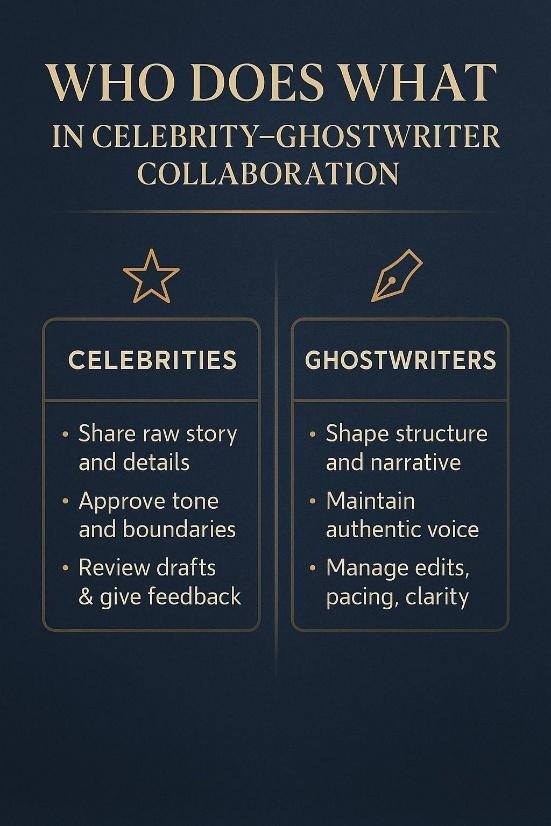
The collaboration works because both sides bring something essential.
Celebrity Contribution
- Personal stories
- Memories and emotional details
- Access to photos, journals, or behind the scenes information
- Approval over tone, structure, and final message
Ghostwriter Contribution
- Organization and narrative structure
- Clear writing and polished language
- The ability to turn raw stories into a page turning arc
- Sensitivity with emotional material
- Consistency in tone across all chapters
It is a partnership built on trust. The celebrity offers authenticity. The writer offers craft.
3. Different Levels of Involvement
Not all celebrities participate the same way. Some are deeply hands on. They read every draft, make notes, rewrite dialogue, and shape the final voice. Others take a lighter approach. They prefer to tell their stories during interviews and then review the finished manuscript. Both methods are normal. The workflow simply adjusts to suit the celebrity’s style and availability.
4. Credit and Payment
Ghostwriters are usually paid in one of two ways. Some receive a flat fee for the entire project. Others negotiate a percentage of the advance or royalties, especially for high profile books with strong sales expectations. Credit varies as well. A ghostwriter might receive a visible “with” credit on the cover, a mention in the acknowledgments, or no public credit at all if the contract requires anonymity.
How to Tell If a Celebrity Book Might Be Ghostwritten
Figuring out whether a celebrity book was shaped by a ghostwriter is not always simple. Confidentiality agreements keep many collaborations invisible, and publishers rarely draw attention to the writing process. Still, readers can spot subtle clues that suggest a professional writer helped create the final manuscript. These signs do not guarantee involvement, but they offer a realistic way to understand how often celebrity ghostwriters contribute behind the scenes.
1. Clues on the Cover and Title Page
One of the easiest places to look is the cover. If you see a line that reads “with [Name]” or “as told to [Name],” that is a clear sign of collaboration. Sometimes the co-writer’s name appears in smaller text or in a different font. The title page inside the book may also list an additional writer even if the cover does not. These choices are deliberate. They signal that a professional writer helped shape the narrative, even if the celebrity remains the primary author.
2. The Acknowledgments Section
Many ghostwriters are thanked directly in the acknowledgments. The language varies, but you might see lines like “Thank you for helping me find my voice,” “Thank you for shaping these stories,” or “Thank you for turning hours of conversation into this book.” These notes hint at the level of involvement without breaking confidentiality. In some cases, the acknowledgment is the only public sign that a ghostwriter played a major role.
3. Publisher Patterns
Certain publishers, imprints, and celebrity focused book lines consistently pair celebrities with professional writers. These teams know how to manage tight deadlines, protect the celebrity’s voice, and keep the project moving from concept to manuscript. If a publisher is known for producing multiple celebrity bestsellers, it is likely that a ghostwriter supported the process. Experienced readers sometimes track these patterns to understand how a book came together.
4. Realistic Expectations
Even if there are no visible clues, it is safe to assume that many celebrity memoirs involved professional writing support. The combination of tight schedules, high emotional stakes, and strong commercial expectations makes it difficult for a busy celebrity to write an entire book alone. A polished narrative, clear structure, and consistent tone often point to a writer who knows how to craft long form stories.
Ghostwriting is not about hiding the truth. It is about helping someone tell their story in the strongest way possible. Once you know the signs, you can read celebrity books with more clarity and appreciation for the team effort behind them.
Is It “Cheating” to Hire a Ghostwriter? A Reader’s Perspective
The idea of ghostwriting can stir strong emotions. Some readers feel disappointed when they learn a celebrity did not write every word of their memoir or advice book. Others shrug and focus on the story itself. The truth is more nuanced. Understanding how readers think about ghostwriting helps clarify why the practice feels controversial for some people and completely normal for others.
1. What Do Readers Actually Feel?
Reactions fall along a wide spectrum. Some readers feel betrayed when they discover a hidden writer. They believed every sentence came directly from the celebrity, so the revelation breaks the illusion of intimacy. Other readers simply want a good story. They care about honesty in the narrative, not about who shaped the prose. If the book resonated with them, they are fine with the collaboration.
Most people land somewhere between those two points. They understand that celebrities have limited time, but they still want transparency. They do not want to feel misled. When the partnership is acknowledged, even in a small way, readers tend to accept it far more easily.
2. Comparisons to Other Arts
Ghostwriting is not unique to publishing. Musicians record songs written by professional songwriters. Actors perform scripts written by screenwriters. Politicians deliver speeches crafted by communication teams. Collaboration forms the foundation of many creative fields. Publishing is no different. Celebrities bring the story and the lived experience. The writer brings the craft. Together they create a final product stronger than either could produce alone.
3. A Middle Path View
A balanced perspective accepts ghostwriting when certain conditions are met. Many readers and industry professionals feel ghostwriting is ethical if:
- The story truly belongs to the celebrity.
- The ghostwriter receives fair compensation.
- The collaboration is at least acknowledged, especially for memoirs and nonfiction advice books.
This approach values honesty without punishing collaboration. It also respects the reader’s desire for transparency.
4. How the Culture Is Shifting
Publishing conversations are changing. More writers, agents, and editors advocate for visible credit. Some celebrities are now open about their partnerships. They talk about interviews, writing sessions, and revisions. This shift helps normalize the process and builds trust with readers.
Younger audiences also care more about authenticity. They appreciate honesty about how a book was made. When a celebrity acknowledges the help they received, it strengthens their connection with fans instead of weakening it.
If You Are a Public Figure, Should You Use a Ghostwriter?
If you are a public figure with a story to tell, the idea of hiring a ghostwriter can feel complicated. You might wonder if it is cheating, if the book will still feel like you, or if readers will judge you for getting help. These questions are normal. The truth is that many public figures benefit from partnering with a professional, and the right collaboration can make your message clearer, stronger, and far more impactful. In some cases, support from a writer or even someone who offers affordable book editing can mean the difference between a manuscript that struggles and a book that connects.
1. When It Makes Sense to Hire a Ghostwriter
There are specific situations where bringing in a ghostwriter is not just helpful but strategic.
You Have a Strong Story but No Time to Write It
If your schedule is packed with speaking events, projects, performances, or leadership responsibilities, you may not have months to sit down and write a book. A ghostwriter steps in to handle the heavy lifting so you can stay focused on your work.
You Want the Book to Represent You Accurately
A polished, professional book reflects your reputation. Ghostwriters help ensure your message is clear, your voice is consistent, and your story maintains emotional truth even when the writing itself takes time and technique.
Your Story Involves Complex or Sensitive Material
Topics like trauma, recovery, grief, or legal issues require careful handling. A ghostwriter helps navigate these areas in a way that protects both your emotional wellbeing and your public image.
2. How to Choose the Right Ghostwriter
Finding the right partner is essential. Here is what to look for:
Relevant Experience
Choose someone who understands your genre. Memoir writing demands emotional depth. Business books require structure and clarity. Lifestyle books need a warm, engaging voice. The right writer understands the expectations of your category.
Ability to Match Your Voice
A great ghostwriter listens closely. They pick up on your phrases, your tone, your humor, and your rhythm. Their job is to sound like you, not like themselves.
A Clear Contract
The agreement should outline the scope of work, timeline, payment structure, confidentiality terms, credit expectations, and rights. A clear contract protects both of you.
3. What a Healthy Collaboration Looks Like
A smooth partnership feels supportive rather than stressful. You should feel heard, respected, and represented. A good collaboration includes:
- Open communication
- Clear expectations
- Regular check ins
- Honesty about deadlines
- Mutual respect for creativity and privacy
A ghostwriter does not replace your voice. They amplify it. They take your ideas, your stories, and your personality, and they shape them into a book that feels real, complete, and true to who you are.
FAQs
Q1. Do most celebrities write their own books?
In many cases, no. Industry insiders and publishing surveys suggest that a large percentage of celebrity memoirs and many business books are ghostwritten or heavily co-written. This often happens quietly because confidentiality agreements keep the collaboration private.
Q2. Is it dishonest for a celebrity to use a ghostwriter?
It depends on your perspective. Legally, it is completely allowed. Ethically, many people feel it is acceptable when the story genuinely belongs to the celebrity and the collaboration is acknowledged in some way, such as a “with” credit or a mention in the acknowledgments.
Q3. Are ghostwriters ever credited on celebrity books?
Yes. Some ghostwriters appear on the cover with a small “with” or “and” credit. Others are thanked in the acknowledgments. In some cases, the contract requires total anonymity, so the writer remains invisible to the public.
Q4. What kinds of celebrity projects use ghostwriters most often?
Memoirs and autobiographies are the most common. After that come business books, lifestyle titles related to wellness, food, or fashion, and then speeches, articles, and even social media content.
Q5. How much do ghostwriters get paid for celebrity books?
Payment varies widely. Some ghostwriters work for a flat fee. Others negotiate a share of the advance or royalties, especially when the book is tied to a major public figure. High profile projects generally pay more, but the range is broad.
Q6. Can a celebrity still be considered an “author” if they hire a ghostwriter?
Many people in the industry say yes, because the ideas, stories, experiences, and approvals come from the celebrity. The writer shapes the prose, but the content still belongs to the person whose name appears on the cover. Others believe that “author” should mean the person who actually wrote the sentences.
Q7. Do influencers and digital creators use ghostwriters too?
Absolutely. As influencer brands grow, expectations for polished content increase. Many creators hire writers to help with books, newsletters, email sequences, and even social media captions. The more content a public figure produces, the more likely they are to work with a professional writer.
Conclusion
Celebrity books, speeches, and long form posts often feel polished for a reason. Behind many of them is a collaborative process that blends a public figure’s lived experience with a writer’s craft. Some readers feel surprised when they learn this, but the truth is simple. Ghostwriting is not a trick. It is a tool. It allows stories that might otherwise stay unspoken to reach readers in a clear and powerful way. Even though opinions vary, the work of celebrity ghostwriters helps shape narratives that feel authentic, readable, and emotionally honest.
If you understand how these partnerships function, you can read celebrity content with a clearer perspective. You know what goes into the final product. You know how the story is shaped. And most importantly, you know that a well written book is almost always the result of teamwork, not just a famous name working alone.