Confused about what counts as ghostwriting vs editing or collaboration? This guide breaks down the definition, legal rules, ethical boundaries, and real-world examples, plus checklists for clients and writers.
Introduction
You have a story to tell, a brand to build, or a message that matters. But writing? That part trips you up. Or maybe you’re good at it, but you don’t have the time or structure to do it right. So you bring in someone to help. But here’s the confusing part. Are they an editor? A collaborator? Or are they a ghostwriter?
That’s where it gets complicated. What is ghostwriting, exactly?
Ghostwriting has been around for decades. Now it’s everywhere. Behind bestselling books, CEO blogs, online courses, speeches, and polished social media posts, there’s often someone writing behind the scenes. And most people aren’t clear on what actually qualifies as ghostwriting compared to editing or co-writing. If you’re a writer or a client, not knowing the difference can cause real problems. Misunderstandings. Legal risk. Even ethical mistakes.
I’ve seen writers cross the line from editing into ghostwriting without realizing it. I’ve seen clients assume they own something they didn’t fully create. I’ve seen projects fall apart because expectations were never clearly set.
This guide will fix that.
You’ll get a clear definition of what qualifies as ghostwriting. You’ll understand how it differs from similar roles, where the legal and ethical lines sit, and how to protect your work, your name, and your reputation. Whether you’re hiring a ghostwriter or working as one, this will give you the clarity you need.
By the end, you’ll know how to label your project, how to handle credit, and how to avoid the gray areas that confuse so many people.
What Ghostwriting Is (And Is Not)
Let’s keep this simple.
Ghostwriting means one person writes content that gets published under someone else’s name. The ghostwriter is paid, but the credit goes to the client. That’s the basic idea.
But in practice, it’s not always that clean. The line between ghostwriting, editing, and co-authoring gets blurry fast. So let’s define what truly qualifies.
The Three Elements That Make It Ghostwriting
For a writing project to count as ghostwriting, these three things need to be true:
- The client is the public “author”
Their name is the one that appears on the work. Whether it’s a book, a blog, or a speech, the audience believes they wrote it. - The ghostwriter is paid to create the content
This is a professional service. The writer gets paid to deliver the work, even if their name is never attached to it. - There is a clear understanding that the writer stays uncredited
This may be in a contract or just part of the verbal agreement. But both sides know the ghostwriter’s name won’t appear publicly.
If all three of these apply, you’re looking at ghostwriting.
What Does Not Count as Ghostwriting
Not every behind-the-scenes writing job is ghostwriting. Here’s what doesn’t qualify:
- Copywriting
Writing sales emails, ad copy, or landing pages for a brand is not ghostwriting. These are marketing deliverables, not credited authorship. - Co-authoring or “with” credit
If the writer gets their name on the cover or byline, even in small print, that’s a shared credit. It’s not ghostwriting. It’s a collaboration. - Anonymous or pen-name writing
If you write under a fake name or choose to stay anonymous but you still created the work, that isn’t ghostwriting. You’re still the author.
Plenty of clients reach out to top ghost writing companies without knowing the difference. They think hiring a ghostwriter just means getting help with their words. But once someone else is doing the writing and you are taking full credit, that is ghostwriting.
What Counts as Ghostwriting in Practice?
Even when you know the definition, ghostwriting in the real world doesn’t always look the same. Some projects involve building everything from a blank page. Others start with a jumble of notes or rough recordings that need to be reshaped into something meaningful.
So what actually qualifies as ghostwriting when you’re out there doing the work?
Let’s break it down.
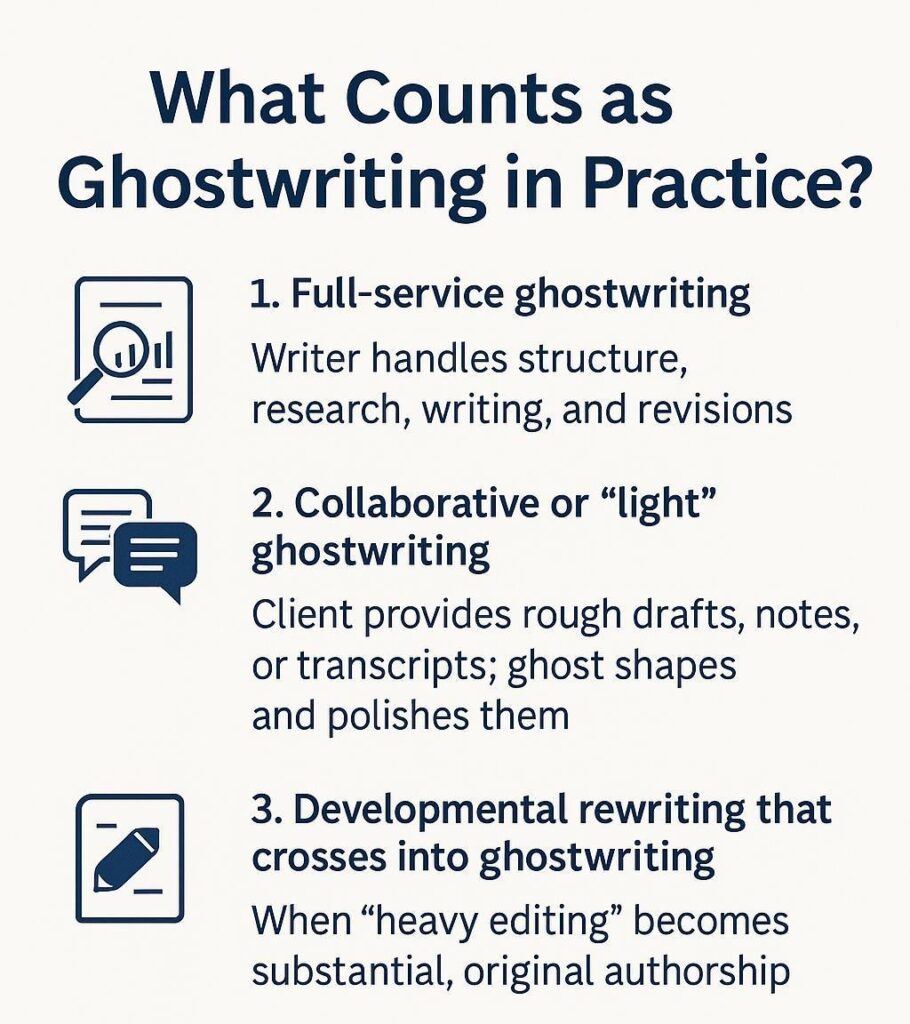
Full-Service Ghostwriting
This is the most straightforward version. The ghostwriter does everything from beginning to end.
That usually includes:
- Creating the outline
- Conducting interviews
- Researching the topic
- Writing the first draft
- Handling revisions based on client feedback
The client might give the vision or key talking points, but the writer is the one turning that vision into a finished product. This is common with executive memoirs, nonfiction books, and thought leadership pieces.
Collaborative or Light Ghostwriting
In this model, the client plays a bigger role in the early stages. They may provide:
- Voice recordings
- Bullet-point notes
- Existing blog posts or presentations
- Transcripts of conversations
The ghostwriter then shapes that material into structured content. The writer adds clarity, flow, and tone while keeping the client’s original ideas at the center. This setup is common for founders, experts, or consultants who have strong ideas but no time to write.
Developmental Rewriting That Becomes Ghostwriting
Sometimes a project starts as editing and turns into something much more. Maybe the client submits a rough draft that needs major work. The ghostwriter restructures chapters, rewrites large sections, and creates new content to fill in gaps.
When that happens, authorship starts to shift. If the final product reflects the ghostwriter’s voice and structure more than the original draft, it moves into ghostwriting territory.
This often comes up when a book publishing consultant brings in a writer to help fix or finish a struggling manuscript. It may begin as editing, but once the writer takes the wheel, it becomes something else entirely.
Industry Examples of Ghostwriting
Ghostwriting is everywhere. These are some of the most common places it shows up:
- Books and Memoirs: Business leaders, athletes, and public figures often rely on ghostwriters to tell their stories.
- Business Content and Thought Leadership: Founders and executives hire writers to publish under their name in outlets like Forbes or LinkedIn.
- Speeches and Public Communication: Politicians, CEOs, and conference speakers often use ghostwriters to craft talks that sound like them but hit the right tone.
- Blogs, Newsletters, and Social Media: Many brands and personalities use ghostwriters to keep their content consistent and professional across platforms.
If you are writing original content that someone else will put their name on, and you are being paid to do that work, you are ghostwriting. The format may change, but the role stays the same.
Borderline Cases: When Does Work Qualify as Ghostwriting?
Not every writing project fits neatly into a category. Some fall into the messy middle. A client thinks they’re paying for editing, but the writer ends up rewriting most of the work. A speech is drafted by an assistant and then polished by someone else entirely. So where do you draw the line?
These borderline cases are common. And if you’re not careful, they can lead to confusion, disputes over credit, or even legal trouble. Here’s how to think through the gray areas.
Heavy Editing vs. Ghostwriting
Editing is about improving existing content. But when an editor starts rewriting sentences, restructuring chapters, and adding original material, the line begins to blur.
If you’re changing more than 40 or 50 percent of the content, or replacing the original voice with your own, you’re probably ghostwriting. At that point, you are no longer just cleaning up someone else’s writing. You are contributing original thought and language.
Writers and clients often disagree here, especially when expectations aren’t clear from the start.
Book Doctoring and Coaching
Book doctors and writing coaches help authors improve their drafts. They may restructure the manuscript, suggest stronger narrative arcs, or tighten the message.
But as long as they don’t write full sections themselves, it isn’t ghostwriting. They are guiding, not creating. Once they start writing actual chapters based on the author’s notes or direction, it crosses over.
Credit-Sharing Options
Sometimes, a project involves shared credit. You might see:
- “By Jamie Smith with Taylor Green”
- “As told to” in a memoir
- Acknowledgments thanking the writer for their help
These options recognize the ghostwriter’s role, at least partially. While it’s still a form of ghostwriting, it’s more transparent and collaborative than the fully invisible version.
What About AI?
In 2025, AI tools are everywhere. If a client uses AI to generate a draft, then hires a writer to polish it, is that ghostwriting?
It depends. If the writer is shaping the AI-generated content into a finished product that will be published under someone else’s name, then yes, it counts.
The key question is still what is ghostwriting. It’s not about tools or input sources. It’s about authorship, credit, and intent. If someone pays you to write content they will claim as their own, that’s ghostwriting.
Legal Side: When Ghostwriting Is Legitimate and When It Is Not
Most ghostwriting work is perfectly legal. It’s no different than hiring a designer to build your website or a contractor to renovate your house. You pay someone for a service, and you own the result.
But there are a few places where ghostwriting crosses a legal line. That’s why every serious ghostwriter and every client should understand the rules before starting a project.
Ghostwriting Is Legal in General Publishing and Business Content
If you’re writing a business book, blog, or personal memoir, ghostwriting is absolutely legal. As long as the content is original, and there is no intent to deceive, you’re on solid ground.
Ghostwriting becomes a legal issue only when it involves:
- Misrepresentation of credentials
- Defamation or libel
- Fraud or false advertising
In typical content creation, these risks are low. Still, every professional should take care to keep projects honest and well-documented.
Work-for-Hire and Copyright Ownership
In the United States, ghostwriting is usually treated as a work-for-hire relationship. That means the writer is paid to create something that the client will own. Unless the contract says otherwise, the client holds the copyright.
This is one of the most important legal points in ghostwriting. If there is no written agreement, the copyright may legally belong to the writer. That’s why even top ghost writing companies insist on contracts that clearly transfer rights from writer to client.
Where Legal Risks Start to Show Up
Some industries are more sensitive than others. Here are a few places where ghostwriting needs extra caution:
- Medical content: Ghostwritten articles by doctors can raise issues if they hide financial ties or promote unsafe treatments.
- Academic work: Writing someone’s thesis or essay is often considered cheating or academic misconduct.
- Legal writing: Ghostwriting legal documents for someone who is not a client or without proper disclosure can raise ethical flags with bar associations.
In these contexts, ghostwriting is not just frowned upon. It may break professional codes or even laws.
Why Every Ghostwriting Project Needs a Contract
No matter how small the job is, a written contract is essential. It should cover:
- Scope of work
- Deadlines and revisions
- Payment terms
- Copyright transfer
- Confidentiality
- Credit and anonymity
Without a contract, you are leaving yourself exposed. Even honest clients and writers can misremember or misinterpret a handshake deal.
Ethics: When Ghostwriting Is Acceptable and When It Crosses a Line
Ghostwriting often walks a fine line. It is legal in most professional and publishing contexts, but legality doesn’t automatically make it ethical. And in some industries, it can raise serious questions about credibility, authorship, and transparency.
So when is ghostwriting a fair and professional service, and when does it become something more questionable?
Let’s break that down.
The Ethical Case for Ghostwriting
At its core, ghostwriting is a type of service work. A client has ideas, a story, or a message. The ghostwriter brings the writing skills to bring that message to life. The client owns the vision. The writer helps shape it.
This is no different than hiring a graphic designer to create a book cover or a coach to structure a keynote speech. Ghostwriting is just another form of delegation. The difference is that it happens with words.
Think about professional book editors. They often rewrite entire sections, reorganize chapters, and adjust the author’s voice so that the final work is stronger and clearer. Ghostwriters do similar work, often starting from scratch instead of editing existing material. The difference is scale, not ethics.
When the client is clear about their ideas and the writer helps them express those ideas accurately and responsibly, ghostwriting becomes a valid and ethical form of collaboration.
What Makes Ghostwriting Ethical?
Ethical ghostwriting respects everyone involved: the client, the writer, and the reader. That means:
- There is full transparency between client and writer
Both parties agree on the terms. The writer knows what they’re being asked to do. The client understands what’s being delivered. - The ideas belong to the client
The writer is not inventing a life story, academic findings, or medical knowledge out of thin air. They’re giving form to the client’s message. - The work is original
Ethical ghostwriting does not involve copying or plagiarism. It also avoids rewording someone else’s content just enough to get by. The writing is unique to the project and the client. - The audience is not misled
Even if the ghostwriter is invisible, the end result should reflect the truth of the client’s experience or knowledge.
Where Ghostwriting Becomes Problematic
Ghostwriting becomes ethically questionable when it’s used to deceive. That can include:
- Making up credentials or expertise
- Writing fake testimonials, reviews, or academic work
- Misleading regulators or readers in medical or legal contexts
- Using ghostwriters to build a persona that isn’t based on the client’s real background
This is where the industry sometimes loses credibility. It’s not ghostwriting itself that’s unethical. It’s how some people choose to use it.
Credit and Acknowledgment
Ethical ghostwriting doesn’t require a public credit line, but it does require honesty within the working relationship. Some clients choose to include ghostwriters in the acknowledgments or even list them as co-authors. Others prefer full anonymity.
Both can be ethical, as long as the ghostwriter agrees to the terms and the audience is not being intentionally misled.
Special Contexts: Academic, Medical, and Legal Ghostwriting
In most industries, ghostwriting is accepted as a professional service. But there are exceptions. In academic, medical, and legal settings, the rules change. What is normal in business publishing could be considered unethical or even misconduct in these high-stakes fields.
Understanding these exceptions is crucial. If you’re writing in one of these niches, or hiring someone who is, you need to know what qualifies as ghostwriting, and when it crosses a serious line.
Academic Ghostwriting: When It Becomes Cheating
In academia, ghostwriting is rarely tolerated. If someone writes a paper, thesis, dissertation, or even a college essay for another person, that is considered academic misconduct.
Most universities treat this kind of ghostwriting as cheating, even if the student pays for the service. The reason is simple: academic work is meant to reflect a student’s understanding and critical thinking. Outsourcing that undermines the integrity of the institution and the value of the qualification.
There are some gray areas. Editing and proofreading are usually allowed. A student might hire someone to fix grammar, check formatting, or improve structure. But once the editor starts rewriting content or contributing ideas, it starts to look like authorship.
If you’re working with students or educational institutions, be cautious. You could be crossing a line without realizing it.
Medical Ghostwriting: A Question of Disclosure
Ghostwriting is also controversial in the medical and pharmaceutical world. When researchers or doctors lend their names to articles they didn’t write, especially if those articles promote a drug or treatment, it raises ethical flags.
The biggest concern is transparency. Readers and regulators need to know where the information comes from and who might have a financial interest in the message. That’s why most medical journals now follow strict authorship guidelines, like those from the International Committee of Medical Journal Editors (ICMJE).
These guidelines require contributors to disclose their roles and relationships. If a ghostwriter is involved, their contribution should be acknowledged. Otherwise, it risks being classified as ghost authorship, which undermines trust in scientific research.
Legal Ghostwriting: Allowed but Regulated
Legal ghostwriting involves drafting legal documents for someone else, usually a client or another lawyer. In many jurisdictions, this is permitted, especially when helping self-represented clients prepare legal filings.
However, some courts and bar associations require that the ghostwriter’s involvement be disclosed. The concern here is that a lawyer might be influencing a case from behind the scenes without being held accountable. Ethical guidelines vary by state and by court, so writers need to understand local rules.
A skilled book publishing consultant working in legal or professional nonfiction should always ask about authorship, disclosure, and contribution before bringing in outside help.
In sensitive fields like these, ghostwriting is not just about skill and delivery. It’s about ethics, transparency, and public trust. What’s acceptable in general publishing may not apply here. Know the rules before you write.
How To Tell If Your Project Qualifies as Ghostwriting
Sometimes it’s obvious. You hire someone to write a book, and your name goes on the cover. That’s ghostwriting. But in many other situations, things feel less clear. Maybe you’re providing rough drafts. Maybe your editor rewrote more than half the content. Maybe you used AI to help generate the first version.
So how do you know if your project really qualifies as ghostwriting?
Here’s how to figure it out, whether you’re the client, the writer, or somewhere in between.
A Simple Checklist for Clients
Ask yourself the following questions. If you answer “yes” to most of them, then you’re hiring a ghostwriter, not just an editor or coach.
- Are you asking someone to write content that will be published under your name?
- Are you paying them for original writing, not just for edits or feedback?
- Do you expect their name to stay off the finished product?
- Will you be the only public face or voice associated with the work?
- Would the audience believe that the final product came entirely from you?
If you answered yes to these, then the person you’re hiring is likely a ghostwriter. That means you should treat the project like a ghostwriting arrangement, including setting clear boundaries in your contract.
A Simple Checklist for Writers
If you’re on the writing side, use this list to evaluate whether you’re ghostwriting or simply collaborating.
- Are you creating new, original content instead of just editing what’s already there?
- Is the client going to be the only one credited publicly?
- Do you have clear terms around confidentiality and copyright transfer?
- Are you helping to structure, draft, or rewrite the project in a substantial way?
- Is your contribution shaping the final voice, message, or flow of the piece?
If you’re doing most of these, you’re acting as a ghostwriter, even if the client calls it something else.
It’s important to be clear on what your role actually is. Ghostwriting is not a lesser form of authorship. It’s a specific, skilled service that should be recognized and protected through contracts, confidentiality, and mutual respect.
Naming Your Work Properly
One of the biggest causes of confusion is how people label their services. Writers call themselves editors when they’re doing full rewrites. Clients think they’re hiring a coach, but they’re really outsourcing the writing.
Knowing what is ghostwriting helps you describe your service or project clearly and honestly.
Here’s a simple way to position it:
- If you are shaping existing content without creating new sections, you’re probably editing.
- If you are giving advice and structure, but not writing, you’re coaching.
- If you are writing large parts of the content that someone else will claim, you are ghostwriting.
Being precise with your language avoids confusion, sets expectations, and protects everyone involved.
Best Practices for Ethical, Clear Ghostwriting Agreements
If ghostwriting is part of your work, whether you’re the client or the writer, a clear agreement is not optional. It protects both sides, sets expectations, and prevents misunderstandings down the line. The best ghostwriting relationships run on trust, but trust needs structure. That’s where a solid agreement comes in.
Here’s how to build one that’s fair, ethical, and clear from the start.
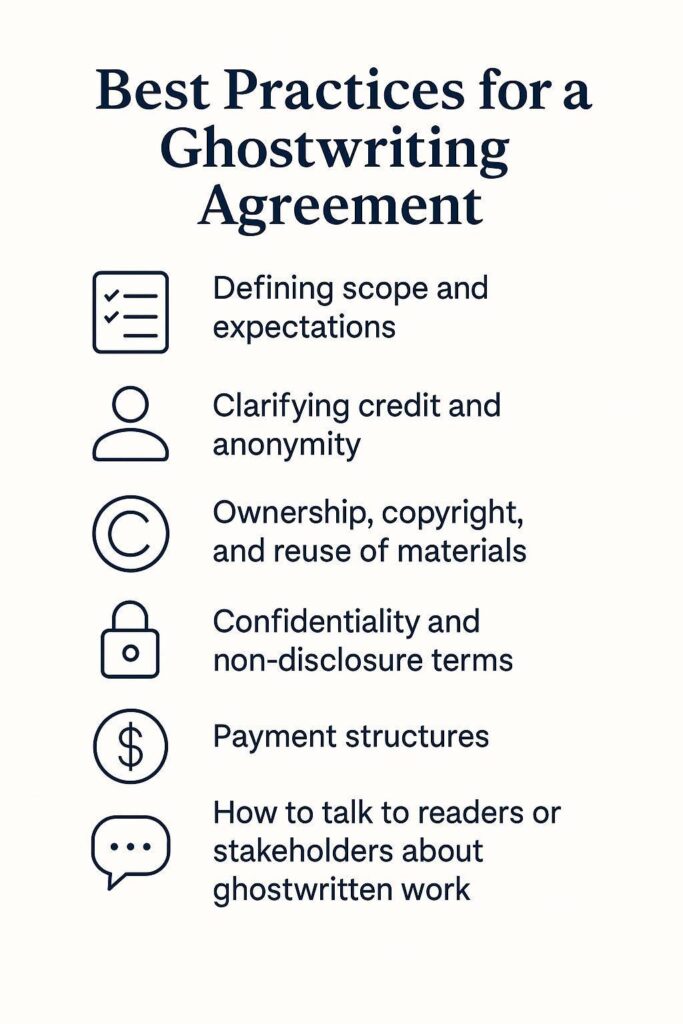
Define the Scope of Work
Start by outlining exactly what’s being delivered. What kind of content is being written? How many drafts are included? Is the writer responsible for research, interviews, revisions, or just the initial draft?
A scope that is too vague will lead to problems later. If the writer thinks they’re delivering a polished article and the client expects a full book with multiple revisions, someone’s going to be unhappy. Be specific.
Clarify Credit and Anonymity
Who will be credited on the final product? Is the ghostwriter truly invisible, or will they be mentioned in the acknowledgments? Will the credit say “with” or “as told to,” or will the writer remain behind the scenes completely?
There’s no one right answer. Some writers want credit. Others prefer to stay anonymous. What matters is that both sides agree from the beginning.
Ownership and Copyright
In most ghostwriting projects, the client owns the final work. But make sure this is stated clearly in writing. The contract should include language about copyright transfer so that the writer understands they are giving up ownership once the work is paid for.
If this is not covered, there could be legal confusion later. Just because the client paid for the work does not automatically mean they own the rights without a written agreement.
Confidentiality and Non-Disclosure
A ghostwriting contract should include a confidentiality clause. This ensures the writer won’t reveal they worked on the project without permission. It also protects any sensitive information shared during interviews or research.
Clients should also agree not to disclose confidential details about the ghostwriter’s process, pricing, or personal information.
Payment Terms
Spell out how and when the writer will be paid. This can be a flat fee, milestone-based payments, royalties, or a hybrid model. Don’t forget to include:
- What happens if the project is cancelled
- Whether revisions are included in the fee
- Any late fees, rush fees, or additional charges
Include a kill fee clause that outlines what the writer gets paid if the project is terminated before completion.
Explaining the Relationship
If someone asks, both parties should be clear on how to describe the collaboration. Whether the writer is described as a consultant, contributor, or ghostwriter depends on the agreement.
Understanding what is ghostwriting means you can label the relationship correctly, avoid miscommunication, and set a professional tone from day one.
Final Verdict: A Practical Definition of What Qualifies as Ghostwriting
By now, you’ve seen how broad and layered ghostwriting really is. It’s not just writing someone’s book. It shows up in blogs, speeches, articles, business communications, and more. The formats and relationships may vary, but the heart of it stays the same.
So let’s define it once and for all.
If you are creating content that someone else will publicly claim as their own, and you are being paid to do that, while remaining out of view, then you are ghostwriting. This holds true whether you’re writing an entire book or shaping someone’s messy voice notes into a clean, finished article.
The Three Core Elements of Ghostwriting
You can recognize ghostwriting by checking for these three things:
- The client is listed as the author
They will be credited for the work, even though they didn’t write the full content. - The writer is paid for the service
It could be a one-time fee, royalty share, or a retainer. But there is compensation for the writing itself. - The writer stays invisible or uncredited
This might be stated in the contract or simply agreed upon in the working relationship. Either way, the ghostwriter will not receive public recognition unless otherwise arranged.
If those three points are true, the project qualifies as ghostwriting.
Treat Ghostwriting Like Any Other Professional Service
Ghostwriting is not a shortcut or a secret. It is a professional service just like copyediting, graphic design, or marketing. Clients turn to ghostwriters when they have ideas but not the time, writing skill, or clarity to bring them to life.
In fact, many ghostwriters work alongside editors, publishers, and teams that provide book publishing services. When handled correctly, ghostwriting is an essential part of helping a message reach a larger audience through books, blogs, or speeches.
Why Clarity and Ethics Matter
Ghostwriting only becomes unethical when it is used to deceive. That includes fake testimonials, false credentials, or plagiarism. None of those have a place in a professional writing relationship.
Understanding what is ghostwriting helps you frame the project correctly, set expectations clearly, and create an agreement that respects everyone involved. When both the client and the writer are honest about the goals and the process, ghostwriting becomes a valuable and respected part of modern publishing.
It is not about hiding. It is about supporting voices that need skilled hands to be heard.
FAQs
1. Is all uncredited writing considered ghostwriting?
No. Ghostwriting specifically involves a paid agreement where one person writes original content that someone else will claim publicly. If an in-house marketing team writes blog posts for a company site and no individual is credited, that does not automatically qualify as ghostwriting.
2. If an editor rewrites large parts of my book, does that qualify as ghostwriting?
It might. If your editor starts creating new sections, restructuring your narrative, or replacing your voice with their own, that crosses the line into ghostwriting. The more original content the writer contributes, the more important it is to discuss authorship and credit honestly.
3. Is ghostwriting legal?
Yes, ghostwriting is legal in publishing, marketing, and business content, as long as the work is original and there is no intent to deceive. Legal and ethical problems arise in specific contexts like academic assignments, medical publications, or legal filings, where authorship and disclosure rules are stricter.
4. Is ghostwriting the same as plagiarism?
No. In ethical ghostwriting, the writer is paid and willingly transfers the rights to the client. Plagiarism involves using someone else’s words or ideas without permission or credit. However, a ghostwriter can still commit plagiarism if they copy from other sources without proper attribution, which puts both the writer and the client at risk.
5. Do I have to reveal that I used a ghostwriter?
In general publishing and business, disclosure is optional. Many authors choose to acknowledge their ghostwriters, but others do not. In academic, legal, and medical contexts, failing to disclose significant writing help can be considered misconduct. Always check the norms for your field.
6. Does using AI to draft content count as ghostwriting?
Not by itself. Ghostwriting refers to a human service where a professional writes on behalf of someone else. However, if a ghostwriter uses AI to assist with research or initial drafts and then shapes the final content that will be credited to the client, it is still considered ghostwriting. The human writer is the responsible author of the finished product.
7. What should be in a ghostwriting contract to stay on the safe side?
A good ghostwriting agreement should include:
A clear scope of work
Payment structure and deadlines
Copyright ownership and transfer terms
Credit and anonymity expectations
Confidentiality and non-disclosure clauses
Revision limits and cancellation terms, including kill fees
Without a contract, both parties are left vulnerable to disputes. A simple written agreement is always worth it.
Conclusion
Ghostwriting is everywhere. It powers bestselling books, thought leadership articles, keynote speeches, and even social media posts. Yet many people still misunderstand what it actually is, how it works, and where the ethical and legal boundaries lie.
If you’re hiring a writer, offering ghostwriting services, or trying to name your role in a collaborative project, clarity matters. Ghostwriting is not a shortcut. It’s not dishonest by default. It’s a professional service built on trust, communication, and clear agreements.
When done well, ghostwriting allows experts, leaders, and creatives to share ideas that might otherwise stay locked inside their heads. It’s not about pretending to be someone else. It’s about helping someone express their story, their voice, or their message with skill and care.
Now that you understand what is ghostwriting, you’re in a better position to approach it with the right mindset. Whether you’re the client or the writer, set expectations early, define the relationship clearly, and always protect the integrity of the work.
Ghostwriting is not just allowed. It’s valuable. It’s powerful. And when handled the right way, it’s something to be proud of.