Discover the real purpose of a biography, beyond dates and achievements. Learn how biographies inform, inspire, interpret history, and preserve human stories, and why they still matter today.
Introduction
A biography is more than a collection of life events. It is written with intention, and that intention shapes how the story is told. Every choice a biographer makes comes back to purpose. Purpose affects which moments are highlighted, how the subject is presented, and what the reader is meant to understand. Even the different types of biographies exist because each one serves a slightly different goal.
Many people know what a biography is, but not why it is written. Some biographies aim to inform readers about a person’s life in a clear, factual way. Others try to explain motivations, reveal character, or offer insight into a particular time or place. Some aim to inspire. Some aim to challenge what readers think they know.
In this article, you will learn what the purpose of a biography really is and how that purpose guides everything that appears on the page.
What Is a Biography?
1. Core Definition
A biography is a detailed and factual account of a real person’s life. It covers significant experiences, relationships, achievements, and challenges, and often places the subject within a clear historical or cultural context. The aim is to give readers an accurate understanding of who the person was and how their life developed.
2. Key Characteristics
A biography is grounded in research. It draws from credible sources such as interviews, documents, letters, and archives. Strong biographies tend to focus on:
- Factual accuracy
- A real individual at the center of the story
- Reliable research and documentation
- An honest effort to portray the subject’s personality and motivations
It is not just a list of events. It tries to show the subject as a full human being.
3. How It Differs From Related Genres
A biography is written by someone other than the subject.
An autobiography is written by the person themselves.
A memoir focuses on particular themes or periods rather than the entire life.
Some people seek out biography authors for hire when they want a professional writer to create a complete, researched account of someone’s life, often for publication or family legacy projects.
This understanding of genre differences helps readers know what perspective each type of life story will offer.
The Main Purpose of a Biography: Inform and Reveal
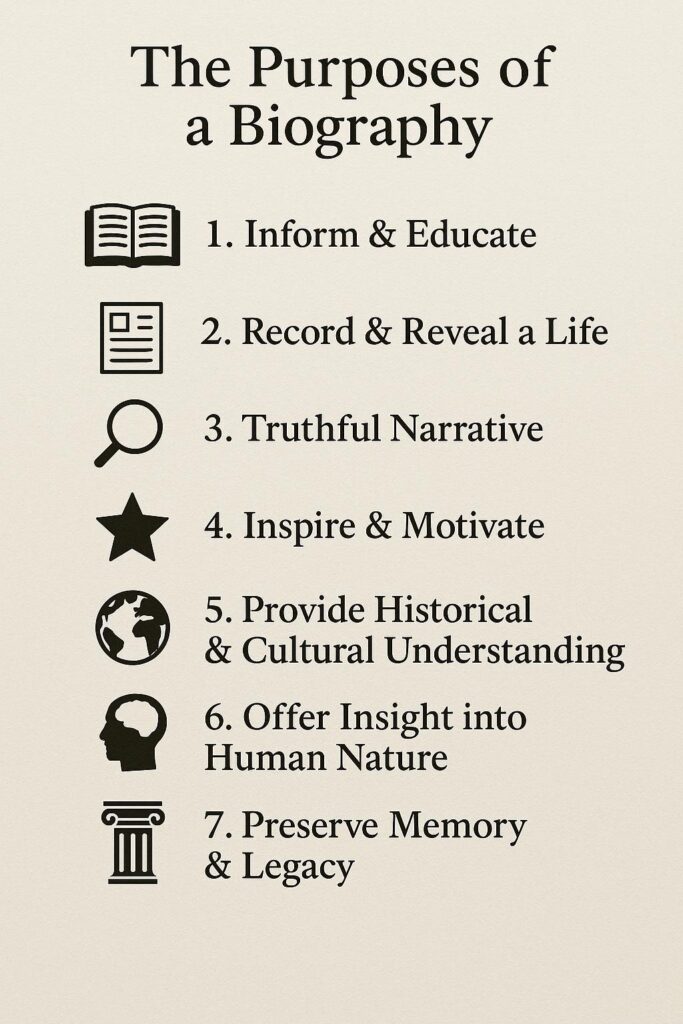
1. To Inform the Reader About a Real Person
The first and most widely accepted purpose of a biography is to inform. A biography gives readers a clear and researched account of a real person’s life. It lays out the major events, the turning points, the challenges, and the influences that shaped who they became. The goal is to help readers understand the person behind the facts in a way that feels grounded and reliable.
This purpose is especially important in classrooms and historical study. When you read a biography, you learn about a particular individual and also about the world they lived in. The person’s experiences, choices, and circumstances help you understand the broader time period. A strong biography teaches through detail. It explains not only what happened but also how those events formed a human life.
Accuracy is central to this purpose. A biography relies on verified sources such as interviews, letters, journals, public records, articles, and archival materials. The intention is not to fill in gaps with imagination. It is to build a trustworthy account that reflects the evidence available. That is why biographies require careful research and sometimes years of investigation.
2. To Record and Reveal a Life
Biographies also serve as a form of record keeping. They preserve stories that might otherwise fade away. Many individuals never write about their own lives. Some leave behind only fragments. A biographer studies these pieces and assembles them into a narrative so future readers can understand who the person was and why their life mattered.
To record a life is the basic function. To reveal a life is the deeper one. A biography reveals the subject’s motivations, fears, strengths, and weaknesses. It explores the reasons behind decisions, the relationships that influenced their path, and the moments that changed their direction. This is what separates a biography from a simple timeline. A timeline lists events. A biography interprets them.
This revealing aspect often requires the biographer to look beyond public achievements. Private letters, lesser known interviews, forgotten documents, and conversations with people who knew the subject help bring out the fuller picture. Readers gain insight into the person’s inner world rather than only their public accomplishments.
3. To Provide a Full and Truthful Narrative
A biography aims to present a balanced and truthful account. Balanced does not mean positive. It means complete enough to help the reader see the individual as a real human being. That includes success and failure, strengths and flaws, moments of confidence and moments of uncertainty. A selective or overly flattering story does not fulfill the purpose of biography.
This focus on truth is also what sets biography apart from other life writing formats. Memoirs, for example, create meaning through personal reflection and lived experience. They allow more interpretation, which is why people researching memoir writing pricing often find that memoir projects require a more subjective partnership between writer and subject. Biography, on the other hand, keeps the center of gravity on evidence and documented fact.
Bringing the Purposes Together
When you combine these purposes, you see the essential role that biography plays. It informs the reader, it records and preserves a life, and it reveals the emotional and historical context behind that life. It creates a truthful narrative that helps readers understand a person in full. Because of these purposes, biography remains one of the most valuable tools for understanding real lives and the worlds those lives shaped.
Other Key Purposes: Inspire, Explain, and Interpret
Biographies do more than inform. They also serve a range of secondary purposes that shape how readers connect with a person’s life. These additional purposes help explain why biographies remain relevant and meaningful across different ages, cultures, and reading levels. When you understand these broader goals, you can see why there are many types of biographies and why each one takes a slightly different approach to a life story.
1. To Inspire and Motivate
Many readers turn to biographies to find encouragement. When a biography shows how someone overcame difficulty, made difficult choices, or stayed committed to a goal, it naturally inspires. Readers look for examples of persistence, creativity, leadership, or resilience, and biographies provide real-life cases rather than imagined ones. This is why biographies often appear on reading lists for leadership training, career development, and personal growth. They show what determination looks like in practice, not theory.
2. To Provide Historical and Cultural Understanding
Another important purpose of biography is to help readers understand a specific moment in history. When you read about someone who lived through a war, a cultural shift, or a scientific breakthrough, you learn about that event in a direct and human way. Instead of reading abstract descriptions of a time period, you see how that period shaped a real person’s decisions, values, and opportunities. This human-centered view helps make history more relatable and more memorable.
Biographies also show cultural experiences that might be unfamiliar to some readers. Through a single life, you can learn about traditions, beliefs, struggles, and social conditions. This expands not only historical knowledge but also empathy.
3. To Offer Insight Into Human Nature and Character
Biographies help readers understand why people behave the way they do. By studying a person’s choices, conflicts, and contradictions, readers get a clearer view of the complexity of human nature. This purpose is especially important for students, writers, and anyone interested in psychology or personal development. A biography can uncover patterns in a person’s life that reveal deeper motivations, habits, and fears. These patterns help readers think more critically about how people grow and change over time.
4. To Preserve Memory and Legacy
Finally, biographies preserve stories that might otherwise be lost. Families, communities, and even entire cultures rely on written accounts to keep important memories alive. This purpose is not limited to famous figures. Many family histories, local biographies, and community stories exist for the sole purpose of documenting a life before it disappears from collective memory. For some readers, this is the most meaningful purpose of all.
Purpose From Different Perspectives
The purpose of a biography becomes clearer when you look at it through the eyes of the people who read, teach, and write these life stories. Each group brings its own needs and expectations, which shapes how biographies are created and why they continue to matter. This variety of perspectives also explains why some individuals and families choose to work with biography ghostwriters for hire when they want a life story written with care, accuracy, and a specific focus.
1. For Readers
Readers usually pick up biographies because they want to understand a person’s experience in a deeper way. They want to know what shaped the subject’s beliefs, what challenges they faced, and how their choices influenced the world around them. Readers also look for stories that feel real and relatable, even when the subject lived in a completely different time or place.
Biographies help readers:
- Learn about influential or interesting people
- Explore real examples of resilience, ambition, creativity, or leadership
- Understand historical moments through personal experience
- Experience life from another perspective
- Gain lessons or cautionary insights
For many readers, biography is one of the clearest ways to understand another person’s humanity.
2. For Students and Educators
Teachers use biographies to bring history and social studies to life. Instead of memorizing dates or reading broad summaries, students get to see how real people experienced events. This approach strengthens comprehension and makes abstract concepts easier to grasp.
Biographies help students:
- See history as lived experience
- Practice identifying cause and effect
- Recognize bias and evaluate sources
- Build empathy through personal stories
- Connect personal decisions to broader events
Because of these benefits, biographies appear in classrooms across many subjects and grade levels.
3. For Writers and Historians
Biographers and historians approach life stories with a research mindset. They often want to clarify misconceptions, introduce new findings, or highlight overlooked contributions. Writers use biography to explore how personal experiences connect to larger cultural, political, or artistic shifts.
This perspective includes goals such as:
- Filling gaps in the historical record
- Challenging incomplete or inaccurate interpretations
- Exploring complex or controversial subjects
- Connecting individual lives to broader movements
- Preserving information for future generations
Together, these perspectives show that biography is not a single-purpose genre. It adapts to the needs of readers, students, teachers, and researchers, while staying committed to presenting a truthful and meaningful account of a real life.
How Purpose Shapes the Way a Biography Is Written
The purpose behind a biography influences every part of the writing process. It affects what the biographer includes, the tone they choose, the level of research they use, and even the structure of the final narrative. This is also why there are many types of biographies, each shaped by the specific outcome the writer wants to achieve.
1. Choice of Scope and Focus
A biography written for general readers usually presents a clear and straightforward overview of a person’s life. It focuses on major events, turning points, and achievements. In contrast, a biography written for academic study may go deeper into analysis. It might explore political influences, cultural tensions, or the subject’s internal conflicts. Purpose determines how wide or narrow the story becomes.
For example, a school biography keeps the scope broad and easy to follow. A literary biography might focus heavily on creative influences and personal struggles. A critical biography might examine contradictions or previously overlooked aspects of the subject’s life. The writer makes these choices based on the intended audience and outcome.
2. Tone and Style
Tone shifts depending on why the biography is being written. If the goal is inspiration, the narrative might highlight perseverance or achievements. If the goal is analysis, the writing may take a more investigative or reflective tone. Biographers pay close attention to how they present the subject because tone can guide how readers interpret the person’s actions and motivations.
Biographies that aim to inspire often use accessible language and a steady pace. Those that aim to challenge accepted beliefs may include more questioning, context, and critical interpretation. Tone is not a surface-level decision. It shapes the reader’s experience from start to finish.
3. Use of Research and Sources
The depth of research also comes from purpose. A serious historical biography requires extensive evidence, such as letters, interviews, archives, and recorded testimony. This ensures the story stays accurate and fair. A shorter or more introductory biography may rely on fewer sources, focusing instead on clarity and accessibility.
Writers who want to create a polished and accurate narrative often work with professional editors to refine structure, pacing, and clarity. Some readers even look for the best memoir editing services when they want to improve personal or family life stories that share traits with biography. Careful editing ensures that the final text supports the intended purpose without drifting into unnecessary detail or confusion.
When you look at how scope, tone, and research vary from one biography to another, it becomes clear that purpose is the guiding force. It shapes the story long before the first sentence appears on the page.
Common Misconceptions About the Purpose of a Biography
Many readers approach biographies with assumptions that are not entirely accurate. These misconceptions can limit how the genre is understood and appreciated. Clearing them up helps readers see why biographies matter and what they are meant to achieve. Some misunderstandings also come from confusion between biography and memoir, which is why people sometimes look into memoir writing pricing when they are actually seeking a different type of life story.
1. “It is just entertainment.”
Some readers assume that biographies exist only to entertain. While many biographies are engaging and enjoyable, entertainment is not the main goal. Biographies are designed to inform, reveal, and interpret. Even when the story is written in a lively or narrative style, the primary purpose remains educational and factual. A biography should offer clarity and insight, not simply a dramatic reading experience.
2. “It is always flattering to the subject.”
Another common misconception is that biographies aim to present the subject in a positive light. In reality, many respected biographies take a balanced or even critical approach. A good biographer presents strengths and flaws, achievements and mistakes. The goal is honesty, not praise. Modern biography especially values transparency and evidence, not idealization.
Readers sometimes expect biographies to support the subject unconditionally. However, critical and investigative biographies show the importance of looking at all sides of a person’s life. These works help readers understand complexity rather than accept simplified or polished versions of events.
3. “It only matters for famous people.”
Many people think biographies are meant only for well-known figures. This is far from true. Family histories, local biographies, and community stories all serve important purposes. They preserve memory, record experiences, and share perspectives that might otherwise disappear. Ordinary people often have extraordinary stories that shed light on cultural changes, personal resilience, or historical events.
Biographers regularly write about individuals whose influence is local, personal, or specific to a small group. These works may not appear on bestseller lists, but they hold deep value for the communities and families connected to the story.
Bringing These Misconceptions Into Focus
Understanding these misconceptions helps readers recognize what biography is designed to do. It is not entertainment alone, it is not guaranteed praise, and it is not limited to the famous. Biography has a broader and more meaningful role. It exists to help readers understand lives in detail, place those lives in context, and preserve stories that contribute to our understanding of the human experience.
Why Biographies Still Matter Today
Biographies continue to play an important role in learning, reflection, and cultural understanding. Even with so much information available online, readers still turn to full life stories because they offer depth and clarity that scattered facts cannot match. This is one reason there are many different types of biographies, each designed to speak to a specific need or audience.
1. Helping Readers Understand Complex Eras
A biography gives readers a human entry point into complicated periods of history. Instead of trying to understand an entire era at once, you see that era through one person’s experiences. This makes political movements, cultural changes, and historical conflicts more accessible. Readers learn not only what happened but how it affected real lives.
2. Supporting Leadership and Personal Development
Biographies are valuable tools in leadership training, coaching programs, and personal development. When you study someone’s decisions, challenges, and turning points, you gain insight into your own choices. Readers often use biographies to learn how successful people handled setbacks, stayed committed to goals, or adapted during moments of pressure. These lessons feel practical because they come from real examples, not theory.
3. Encouraging Reflection on Ethics and Identity
Biographies often raise important questions about values and personal responsibility. As readers follow the subject’s decisions and motivations, they naturally reflect on their own. This makes biography a powerful source of ethical insight. It helps readers consider how beliefs influence actions and how identity develops over time.
4. Connecting Younger Generations to the Past
Biographies help students and younger readers understand people who lived in different times. They show what life looked like before modern technology, social norms, or opportunities. This connection builds empathy and curiosity. It also helps preserve family stories, cultural traditions, and community memory.
5. Offering Stability in a Fast-Paced Information World
In a world of quick summaries and short videos, biographies offer something deeper. They allow readers to slow down and focus on one life in detail. This depth provides a sense of stability and continuity. Readers can see patterns, learn from long-term experiences, and understand how individual choices accumulate over time.
Biographies remain relevant because they help readers make sense of the world through real lives. They provide context, perspective, and meaning in a way that short-form content cannot. Whether you are studying history, looking for motivation, or trying to understand human nature, biographies continue to offer a rich and dependable source of insight.
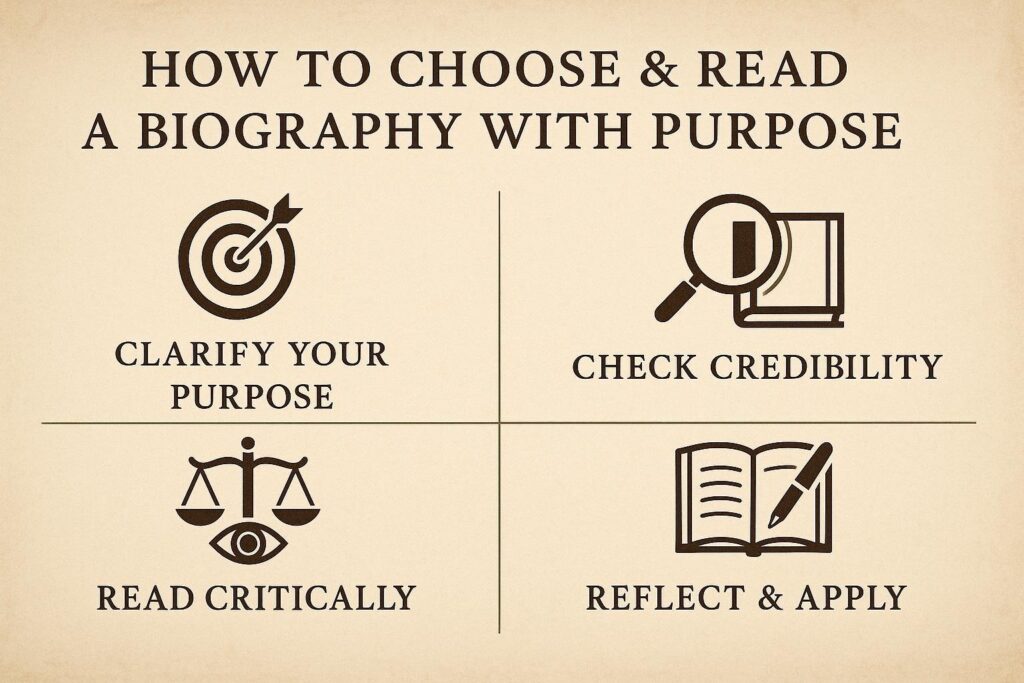
How to Choose and Read a Biography With Purpose
Choosing a biography is easier when you understand what you want from the reading experience. Biographies vary widely in tone, depth, and focus, which is why there are many types of biographies designed for different needs. Whether you are reading for school, personal interest, or professional development, taking a purposeful approach helps you get more value from the story.
1. Clarify Your Own Purpose
Start by asking what you want to learn. Are you interested in a specific historical period, a particular field such as science or art, or a figure who influenced culture or politics? Maybe you are looking for guidance, inspiration, or a deeper understanding of how someone handled challenges. Knowing your goal helps you choose a biography that aligns with the insight you are seeking.
If you want a broad overview, choose a full-length biography that covers the subject’s entire life. If you want a focused exploration of a major achievement or struggle, look for shorter or more thematic biographies.
2. Check Credibility
A good biography should be built on strong research. Before you begin reading, take a moment to check the writer’s background. Look at the publisher, the reviews, and the sources used in the book. Trustworthy biographies rely on interviews, letters, archival documents, and verified records. This careful research ensures the story is accurate and balanced.
If the biography avoids sources or relies heavily on assumptions, it may not offer the level of reliability you need.
3. Read Critically
As you read, pay attention to how the biographer frames the subject’s choices and experiences. Consider questions such as:
- What information is included and what seems missing?
- How does the writer interpret the subject’s motivations?
- Is the portrayal balanced, or does it feel overly positive or negative?
- Does the writer acknowledge uncertainty or conflicting accounts?
Critical reading helps you understand not only the subject’s life but also the writer’s perspective and goals.
4. Connect the Story to Your Own Context
Biographies provide value when you connect what you read to your own experiences. Try taking notes on moments that stand out. Reflect on the challenges the subject faced and how you might handle similar situations. Teachers and students can use journals, discussion questions, or simple reflections to build stronger connections to the material.
When you read with purpose, a biography becomes more than a life story. It becomes a guide to understanding history, human behavior, and your own approach to decision-making and growth.
FAQs
1. What is the main purpose of a biography?
The main purpose of a biography is to record and reveal the life of a real person. A biography presents key events, experiences, and achievements in a researched and accurate way so readers can understand who the person was and why their life matters. It explains the subject’s background, motivations, influences, and impact.
2. Is a biography supposed to be inspiring or just informative?
A biography is primarily informative, but many also inspire. Some biographies highlight resilience, creativity, leadership, or personal growth. Others focus more on analysis and context. The balance depends on the writer’s purpose and the subject’s story. A biography can both inform and inspire without losing accuracy.
3. How is the purpose of a biography different from a memoir or autobiography?
A biography is written by someone other than the subject. Its goal is to present a researched and often comprehensive view of the subject’s life.
An autobiography is written by the subject and covers their life from their own perspective.
A memoir focuses on specific themes or time periods and emphasizes personal reflection rather than full life coverage.
4. Why are biographies important for students?
Biographies help students connect with history and culture in a personal way. They make abstract events easier to understand by showing how a real person experienced them. Biographies also build reading and critical thinking skills such as identifying cause and effect, spotting bias, and separating fact from opinion. They strengthen empathy by placing students in someone else’s perspective.
5. Why do writers choose to write biographies?
Writers may choose biography because they want to preserve a story, correct misinformation, introduce new research, or highlight important themes such as justice, leadership, or creativity. Biographies allow writers to explore how one person’s life connects to larger social or historical changes.
6. Can a biography be critical of its subject, or must it be positive?
A biography can definitely be critical. Many respected biographies are valued because they offer a balanced and investigative perspective. A strong biography includes achievements and flaws. The goal is honesty and accuracy, not praise.
7. What makes a biography “good” at fulfilling its purpose?
A strong biography is well researched, factually accurate, and clearly organized. It provides meaningful context about the time and place in which the subject lived. It portrays the subject as a complex individual rather than a simplified figure. A good biography also remains engaging while staying honest about uncertainty, conflicting sources, and human complexity.
Conclusion
A biography is never just a list of events. It serves a clear purpose that guides every part of the writing process. Whether the goal is to inform, reveal, inspire, interpret, or preserve, each purpose shapes the final narrative in a meaningful way. This is why there are so many different types of biographies, each created to meet a specific need for readers, students, educators, and researchers.
A strong biography helps you understand not only what someone did but why their life matters. It gives context to decisions, highlights turning points, and connects individual experiences to larger moments in history. Good biographers work carefully with evidence, structure, and interpretation. Some even collaborate with biography editors for hire to ensure that the final manuscript is accurate, clear, and balanced.
When you look at biographies through the lens of purpose, the genre becomes easier to appreciate. You start to see how each life story carries meaning beyond the facts. You also begin to understand why two biographies about the same person can feel very different. The purpose behind the book determines the focus, tone, and depth.
As you read or write biographies in the future, take a moment to consider the intention behind the story. Purpose is what gives a biography direction. Purpose is what makes it more than information. And purpose is what turns a collection of life events into a meaningful record that helps others see the world through another person’s eyes.