Introduction
If you’re looking up the correct biography format, it’s probably because you need clear structure, not storytelling flair. And that’s fair. Biographies only work when the information is organized in a logical, predictable way. The challenge is that many guides bury the actual format under vague advice or creative examples, leaving you unsure where each part of the life story is supposed to go.
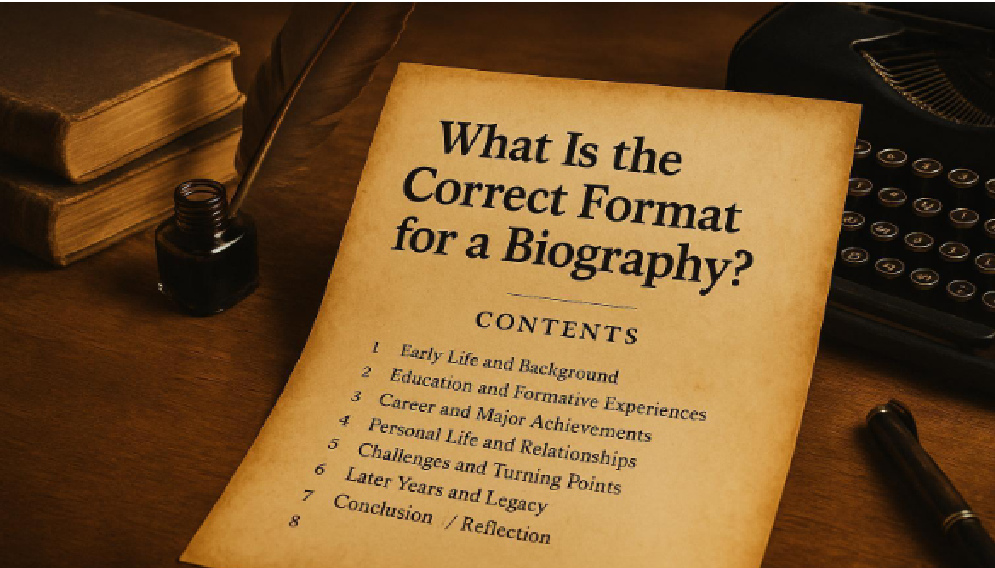
The good news is that biography structure is highly standardized. Whether you’re writing a school assignment, a college essay, or a book-length project, the core format stays almost the same: introduce the subject, establish early life, move through education and career, highlight key achievements and challenges, then close with impact or legacy.
In this guide, you’ll get a precise breakdown of that structure, why it works, and how to adapt the same format for different writing contexts. No narrative experiments, no filler, just the technical framework you can rely on every time you write about someone’s life.
What Exactly Is a Biography (and How Is It Different from Other Life-Writing)?
Definition and Purpose
A biography is a nonfiction account of a real person’s life written in third person. Its purpose is simple: to inform, to interpret, and to present a clear, accurate picture of someone’s experiences, achievements, and influence. Whether you’re writing for school, publishing, or professional biography writing, the core function stays the same. A biography explains what shaped a person and why their life matters.
Biography vs Autobiography vs Memoir
- Biography: Someone else writes the life story, usually covering the entire lifespan from early years to legacy.
- Autobiography: The subject writes their own story, typically in a full cradle-to-present or cradle-to-grave structure.
- Memoir: A focused slice of a life, built around a theme, event, or specific period rather than the entire timeline.
Each type has its place, but only biographies follow the traditional third-person structure used in academic, historical, and many professional contexts.
Common Contexts Where Format Matters
A clear format becomes especially important in settings where organization and accuracy are expected. Examples include:
- School or exam biographies, where teachers look for standard sections like early life, education, and achievements.
- Biography essays, which need a structured introduction, organized body sections, and a concluding reflection.
- Book-length biographies, where the same structure expands into multiple chapters with deeper research.
- Short professional or academic bios, which use a condensed version that highlights current role, expertise, and key achievements.
Understanding these contexts helps you adapt the format without losing clarity or structure.
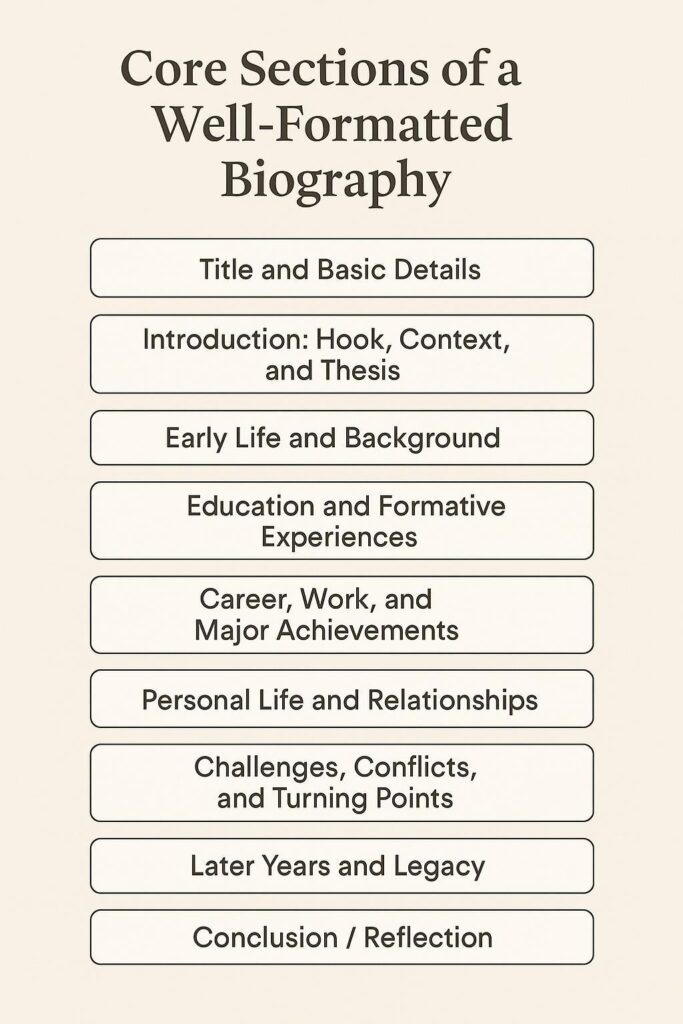
Core Sections of a Well-Formatted Biography
A strong biography follows a structured, predictable flow. This is not about limiting creativity. It is about giving readers a clear path through someone’s life so they never feel lost or unsure why certain details matter. Even the best ghostwriters rely on these components because they provide clarity, consistency, and narrative logic, no matter how long or short the biography is.
Below is an expanded explanation of each core section and how it functions within the overall structure.
1. Title and Basic Details
A biography begins with a clear, informative title. The most effective titles include the subject’s full name and something that communicates their significance. For example, “Katherine Johnson: The Mathematician Who Changed Spaceflight” instantly tells readers who she was and why they should care.
If you want added clarity or emphasis, you can use a subtitle to highlight the theme, era, or main achievement. In longer works, this helps shape readers’ expectations before they begin the first chapter.
2. Introduction: Hook, Context, and Focus
The introduction establishes the subject’s identity and the angle the biography will take. A strong introduction usually includes three elements:
• A hook that grabs attention, such as an important moment, a meaningful quote, or a striking contrast in the person’s life
• A clear explanation of who the subject is and why they matter
• A brief statement of focus that shows what the biography will explore
This is your first opportunity to set the direction and tone of the entire piece.
3. Early Life and Background
This section covers foundational information: birthplace, family circumstances, cultural environment, and formative childhood experiences. The goal is not to list every detail. Instead, focus on early influences that shaped the person’s character, values, or long-term interests. Effective biographies make connections between childhood experiences and later achievements so readers can see patterns across the lifetime.
4. Education and Formative Experiences
Education often plays a major role in who a person becomes. This section includes formal schooling, higher education, training programs, early jobs, and mentors who guided the subject. It can also include formative setbacks that encouraged growth or clarified personal goals. The emphasis is on development, not just credentials.
5. Career, Work, and Major Achievements
For most biographies, this is the longest and most detailed section. Here you outline:
• Career progression
• Major accomplishments
• Innovations or field contributions
• Awards or important recognitions
• Key professional turning points
This is where readers understand the core reason the person became notable.
6. Personal Life and Relationships
Personal relationships shape nearly every meaningful decision a person makes. This section can include marriages, friendships, children, mentors, community involvement, or conflicts when they influence the broader story. The goal is relevance, not trivia.
7. Challenges, Conflicts, and Turning Points
Every life includes obstacles. This section highlights struggles, failures, criticism, crises, or major decisions that changed the subject’s path. Turning points reveal character, motivation, and growth, which makes this part essential to a complete biography.
8. Later Years and Legacy
Describe how the subject’s work evolved in later life and what influence they left behind. Legacy includes impact on their field, cultural influence, ongoing contributions, and how people remember them today.
9. Conclusion or Reflection
The conclusion ties the entire biography together. It should highlight the central lesson, insight, or contribution that defines the person’s life. Instead of summarizing every event, focus on the broader meaning of their story.
10. References and Back Matter
For academic, professional, or book-length biographies, proper sourcing matters. This section can include citation lists, bibliographies, notes, appendices, chronologies, or family trees. These elements reinforce accuracy and credibility.
Choosing the Right Structure for Your Biography
Selecting the structure is one of the most important decisions you will make before drafting. Even when the content is solid, a biography can feel confusing or disorganized if the structure is unclear. The goal is to choose a format that supports the subject’s story and keeps readers oriented from beginning to end. Writers who understand the options can adapt the biography format to fit any assignment or length.
Chronological Structure
A chronological structure is the most widely used approach. It starts with early life, moves through education and career, then ends with later years and legacy. This structure works well for:
• School assignments
• Academic essays
• Historical figures
• Traditional book-length biographies
It is the safest choice when clarity is the priority. Readers always know where they are in the timeline, and the narrative naturally builds toward the subject’s most important achievements.
Thematic and Nonlinear Structures
Not every life story fits neatly into a timeline. In some cases, grouping the material by theme makes more sense. A thematic structure organizes chapters or sections around ideas rather than dates. For example, you might create sections such as The Innovator, The Leader, or The Advocate. This approach works well when the subject’s life revolves around a few dominant themes or repeated patterns.
A nonlinear or framed approach is another option. This structure often begins with a dramatic event near the middle or end of the person’s life. After that key moment, the narrative moves backward to show how the subject reached that point. This can be effective when the opening event defines the entire story or reveals the subject’s core conflict.
A hybrid structure combines mostly chronological flow with a few thematic groupings. It allows flexibility without losing clarity.
Word Count and Chapter Planning
The length of your project will influence how you structure it. Shorter works need tighter organization, while longer works can spread material across multiple chapters. Typical word counts include:
• School biography: 300 to 1,500 words
• Biography essay: 1,500 to 3,000 words
• Book-length biography: 60,000 to 100,000 words, with 6 to 12 main chapters
For longer projects, each chapter usually focuses on a major life stage or theme. This helps maintain pacing and prevents the biography from feeling overloaded with information.
Choosing the right structure ensures the reader can follow the subject’s life clearly, regardless of length or complexity.
On-the-Page Formatting: POV, Tense, Headings, and Style
When you begin drafting, the way you present information on the page becomes just as important as what you include. Strong formatting improves readability, keeps the narrative organized, and supports any biography format you choose.
Point of View and Tense
Biographies are usually written in third person, using he, she, or they. This viewpoint keeps the writing objective and makes it clear that the story is being told from an outside perspective. It also helps maintain a consistent tone across academic, professional, and general readerships.
Most events should be written in past tense because you are describing actions and experiences that already occurred. Present tense can be used for commentary or to discuss the subject’s ongoing legacy, but it should be applied with intention. Switching between tenses without purpose can disrupt the flow, so choose a standard tense and remain consistent.
Headings, Subheadings, and Paragraph Structure
Headings guide readers through each stage of the subject’s life. Labels such as Early Life, Education, or Career make the biography easier to follow, especially in longer works. Subheadings can divide major sections into smaller, clear segments.
Paragraphs should be focused and organized. Each one should cover a single idea or event. This prevents the narrative from feeling cluttered or rushed and helps readers follow transitions across the timeline.
Level of Detail and Tone
Only include details that support the subject’s development or highlight meaningful moments. Avoid overwhelming readers with information that does not connect to the bigger picture.
Tone should be factual and clear. Use straightforward language and avoid unnecessary jargon so the biography remains accessible to a wide audience.
One of the most important investment you could make in your biography writing journey is to hire a professional biography editor. This can take your biography from rough draft to a smooth read. Strong on-the-page formatting creates a polished biography that is easy to read and structurally sound.
Adapting the Format for Different Contexts
A strong biography structure works across many settings, but each context requires adjustments in length, tone, and emphasis. The core sections stay the same, yet the level of detail changes depending on whether you are writing for school, college, or an online publication. The following breakdown shows how to adapt the structure for each purpose.
1. School or Exam Biography Format
School biographies are usually short and straightforward. Teachers expect essential facts delivered in a clear, chronological order. A standard school assignment typically includes:
• A title with the person’s name
• Basic biographical details such as birth and education
• Main achievements or contributions
• A brief summary at the end
The writing should be simple, direct, and easy to follow. Chronological structure works best in this context.
2. Biography Essay for College or Online Articles
Biography essays require more depth and interpretation. They follow a classic essay structure with:
• An introduction that sets the focus
• Body sections organized by headings
• A conclusion that reflects on impact
These essays often include citations or a reference list. The emphasis is on analysis and clarity, not just listing facts. Tone should remain formal and well-supported.
3. Short Professional or Academic Bio
Short bios compress the most important information into a few concise sentences. They typically include:
• Name
• Current role or professional title
• Area of expertise
• Key achievements or credentials
• Location or affiliation
• One small personal detail if appropriate
These are used on websites, company pages, author boxes, conference programs, and professional profiles.
4. Book-Length Narrative Biography
Book-length biographies expand the standard structure into multiple chapters. They often include interviews, primary sources, detailed timelines, and deeper context. Narrative flow matters more here, since readers expect a long-form story supported by strong research.
Adapting the format to the context ensures the biography feels appropriate, clear, and effective for its intended audience.
Step-by-Step Process to Put Your Biography into the Correct Format
Writing a biography becomes far more manageable when you follow a clear, sequential process. This approach helps you organize information, understand what belongs in each section, and maintain accuracy throughout the project. Even the best ghostwriters rely on a structured workflow, because it saves time, reduces confusion, and results in a more coherent final piece. The steps below apply to school assignments, essays, long-form biographies, and professional writing projects.
1. Pre-Writing and Research
Pre-writing is the foundation of the entire biography. Before drafting a single sentence, you need solid information and a clear direction.
- Choose your subject and define your angle
Start by selecting the person you will write about. Then clarify the focus of the biography. This might be the person’s achievements, influence, leadership, creativity, resilience, or a specific theme that shaped their life. Defining the angle early will help you decide which details matter most.
- Secure permission if needed
If your subject is alive, or if you plan to use private materials such as emails, unpublished letters, or interviews, make sure you have permission. This is essential for ethical and legal reasons.
- Gather reliable sources
Collect a mix of primary and secondary sources. Primary sources include interviews, diaries, speeches, letters, and firsthand accounts. Secondary sources include books, articles, documentaries, and reputable websites. Organize your notes by category so they are easy to reference while writing.
2. Decide on Structure and Depth
Once you have your research, you need to decide how the information will be organized.
- Choose your structure
Select either chronological, thematic, or hybrid structure. Chronological works best for clarity. Thematic works best when the subject’s life revolves around key ideas. Hybrid allows you to combine both approaches, which is useful for complex or non-linear life stories.
- Determine the appropriate length
Know whether you are writing a short bio, a biography essay, or a book-length work. Length determines the level of detail you can include. Short projects require tight, selective information. Longer projects allow for multiple chapters, expanded context, and narrative scenes.
3. Outline the Biography Using Standard Sections
A detailed outline becomes your guide while drafting. It prevents the common problem of wandering off-topic or jumping around the timeline.
Assign headings or chapters to major life stages
Use clear categories such as Early Life, Education, Career, Achievements, Challenges, Personal Life, and Legacy. For book-length works, create chapter breakdowns with key events inside each one. This makes drafting smoother and keeps the narrative logical.
4. Draft, Revise, and Format
After planning, you are ready to write the first full version.
- Write the introduction last
Many writers draft the introduction first, but it is easier to write it after the rest of the biography is complete. Once you understand the entire angle and structure, you can craft an introduction that accurately reflects the direction of the piece.
- Maintain consistent organization
Check that your headings, subheadings, and paragraph transitions follow a clear order. Readers should always understand where they are in the timeline and how each point connects to the previous one.
- Revise for clarity and pacing
Look for areas that feel slow, overly dense, or confusing. Remove unnecessary facts, refine long sentences, and make sure every detail supports the story’s focus. Accuracy matters, but readability matters just as much.
- Add citations and references
In academic and professional settings, proper sourcing is essential. Create a complete reference list that includes every source you used. For book-length projects, you may also include notes, appendices, chronologies, or additional reference materials.
Following this step-by-step process ensures your biography is organized, well-supported, and ready for readers who expect clear and accurate storytelling.
Common Formatting Mistakes to Avoid
Even with a strong structure, correct biography format, and solid research, certain mistakes can weaken a biography and make it harder for readers to follow. These issues show up in school assignments, online articles, and long-form projects alike. Recognizing them ahead of time helps you produce a biography that is accurate, coherent, and polished from beginning to end.
1. Presenting Facts Without Clear Structure
One of the most common problems is listing facts with no logical order. When information is presented as a stream of unrelated details, the reader cannot understand how events connect or why they matter. A clear structure with headings and organized paragraphs prevents this issue and guides the reader through each stage of the subject’s life.
2. Overloading the Childhood Section
Writers sometimes spend too much time describing the subject’s childhood and early life. Although early experiences matter, this section should lead into later achievements. If the childhood material does not connect to the rest of the biography, it distracts from the story instead of supporting it.
3. Jumping Around the Timeline Without Signals
Nonlinear structure can be effective, but only when transitions are clear. Jumping back and forth in time without cues confuses readers and disrupts the flow. If you use a thematic or framed structure, make sure the timeline is still easy to follow.
4. Writing in First Person
Biographies should be written in third person. Using I or my makes the piece sound like a memoir or personal essay instead of an objective account. Third person maintains clarity and distance while keeping the focus on the subject, not the writer.
5. Forgetting Sources or Reference Lists
In academic and professional settings, failing to include sources weakens credibility. Even short essays often require citations or a reference list. Longer projects typically need notes, bibliographies, or appendices. Proper sourcing shows that the information is accurate and well-researched.
6. Adding Irrelevant Details
Biographies become difficult to read when they include trivia that does not support the main narrative. Every detail should contribute to the reader’s understanding of the subject’s development, achievements, or impact.
Avoiding these mistakes helps ensure your biography remains clear, well-organized, and effective for any audience.
FAQs: Correct Biography Format and Structure
1. What is the most correct basic format for a biography?
A standard format includes an introduction, early life, education, career and achievements, personal life, challenges, later life, legacy, and a concluding reflection. Most biographies follow chronological order because it creates a clear and logical flow for readers.
2. Do I have to write a biography in chronological order?
Chronological order is the safest and most commonly accepted approach, especially for school or academic work. However, thematic or hybrid structures are also acceptable as long as the timeline stays clear. If you begin with a dramatic event or use a nonlinear approach, make sure transitions help the reader understand where each part fits.
3. Should a biography always be written in third person?
Yes. Third person is the standard for biographies. It keeps the writing objective and signals that the story is being told by an outside observer. First person is used for memoirs or autobiographies, not biographies.
4. How long should a biography be?
The length depends on the purpose.
• School assignment: often 300 to 1,500 words
• Biography essay: typically 1,500 to 3,000 words
• Full book: usually 60,000 to 100,000 words
These ranges can shift based on assignment requirements or publishing goals.
5. What should always be included in a biography, no matter how short?
Include the person’s full name, why they are notable, their main contributions or achievements, and at least one key event that shows their impact. Even short bios need a clear purpose.
6. Can I start a biography with a dramatic moment instead of their birth?
Yes. Many modern biographies start with a pivotal moment and then return to earlier life stages. This can create a strong hook as long as the timeline remains easy to follow.
7. Do I need references or a bibliography?
For school, academic, or professional writing, yes. A reference list or bibliography strengthens credibility and allows readers to verify your information. Short online bios usually do not require sources.
8. What is the difference between a biography and a short professional bio?
A biography covers an entire life or a major portion of it. A short professional bio summarizes key roles, achievements, and expertise in just a few sentences. It is designed for websites, profiles, or introductions, not full storytelling.
Conclusion
A well-structured biography is more than a collection of facts. It is a clear, organized presentation of a person’s life that helps readers understand who they were, what they achieved, and why their story matters. By using consistent sections, maintaining logical flow, and selecting details that support the central theme, you create a biography that is accurate, engaging, and easy to follow.
Whether you are completing a school assignment, writing an academic essay, preparing a short professional bio, or working on professional biography writing, the principles stay the same. Start with strong research, choose the right structure, plan each section carefully, and maintain clarity throughout the draft. When you combine these elements with thoughtful formatting and responsible sourcing, you produce a biography that meets the expectations of any audience.
In the end, a successful biography does two things. It gives readers a reliable, well-organized path through the subject’s life, and it highlights the impact that person left behind. With the right approach and a clear format, you can tell any life story with confidence and precision.